Trident Help

Classic CAS manual · Chapter 10 of 16

Calculus

Derivatives, integrals, limits, sums, products, Taylor series, and numeric calculus.

10.1Find a derivative#

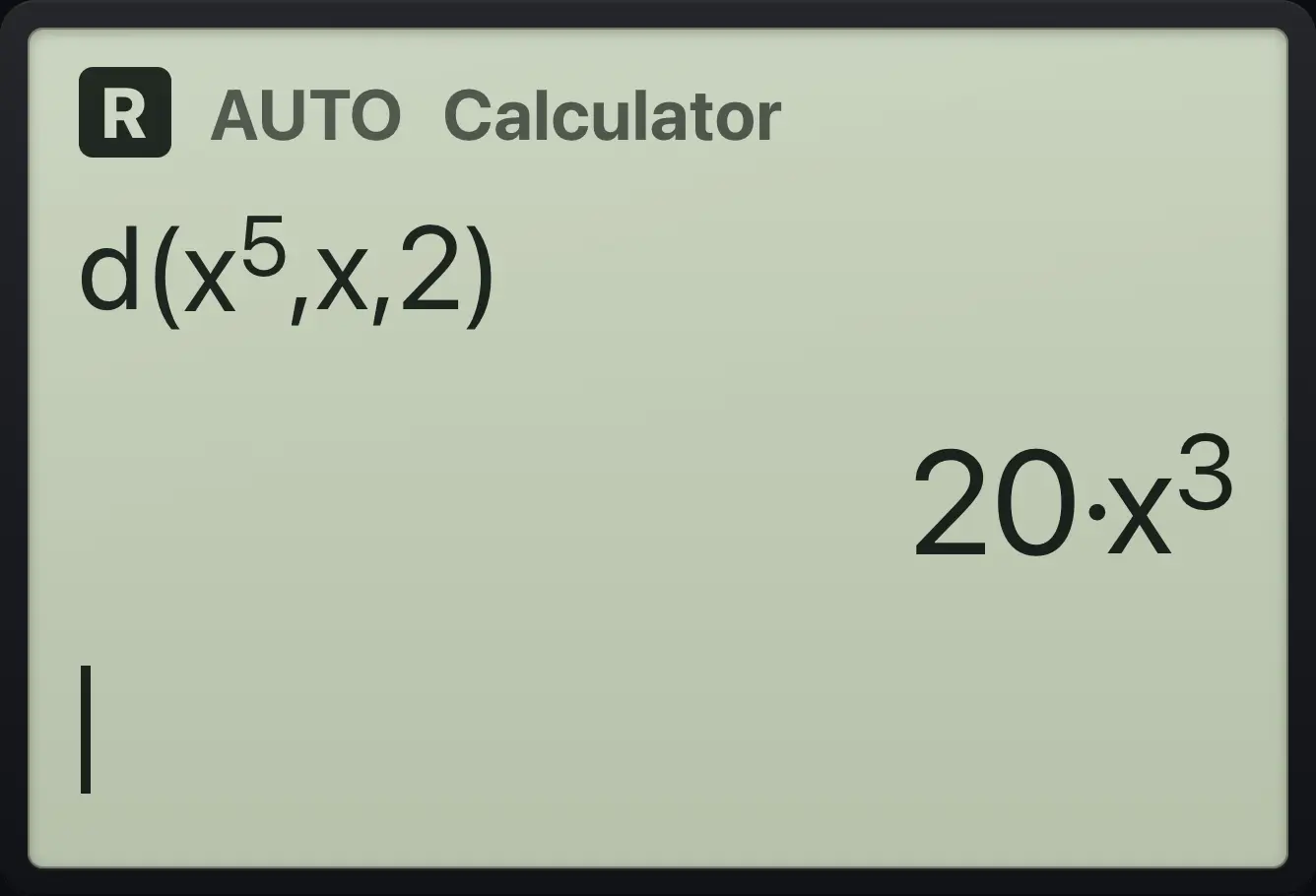
Open templates and choose Derivative (8). Type the variable, press ▶, then the expression. You can also type d(expression, variable). A third number is the order: d(f, x, 2) is the second derivative.

ddxsin⁡(x2)=2xcos⁡(x2)\frac{d}{dx}\sin\left(x^2\right)=2x\cos\left(x^2\right)
The chain rule, done for you.
Example 10.1

Derivative of sin(x²)

  1. Open templates, choose 8, type x and press right.

    templates8x▶
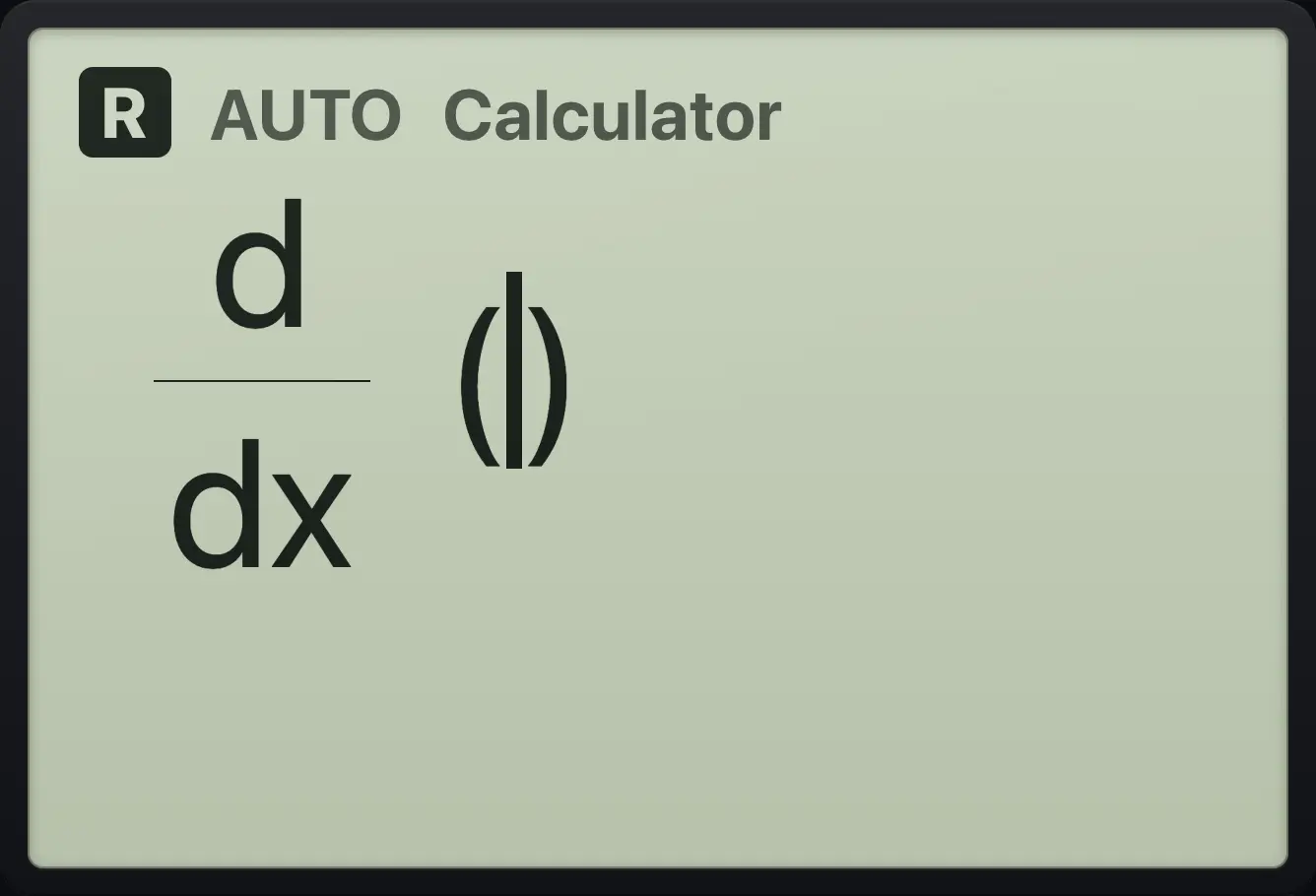
    After step 1: Open templates, choose 8, type x and press right. The display shows: d/dx().
  2. Type sin(x²) and press enter.

    sin(x^2▶)enter
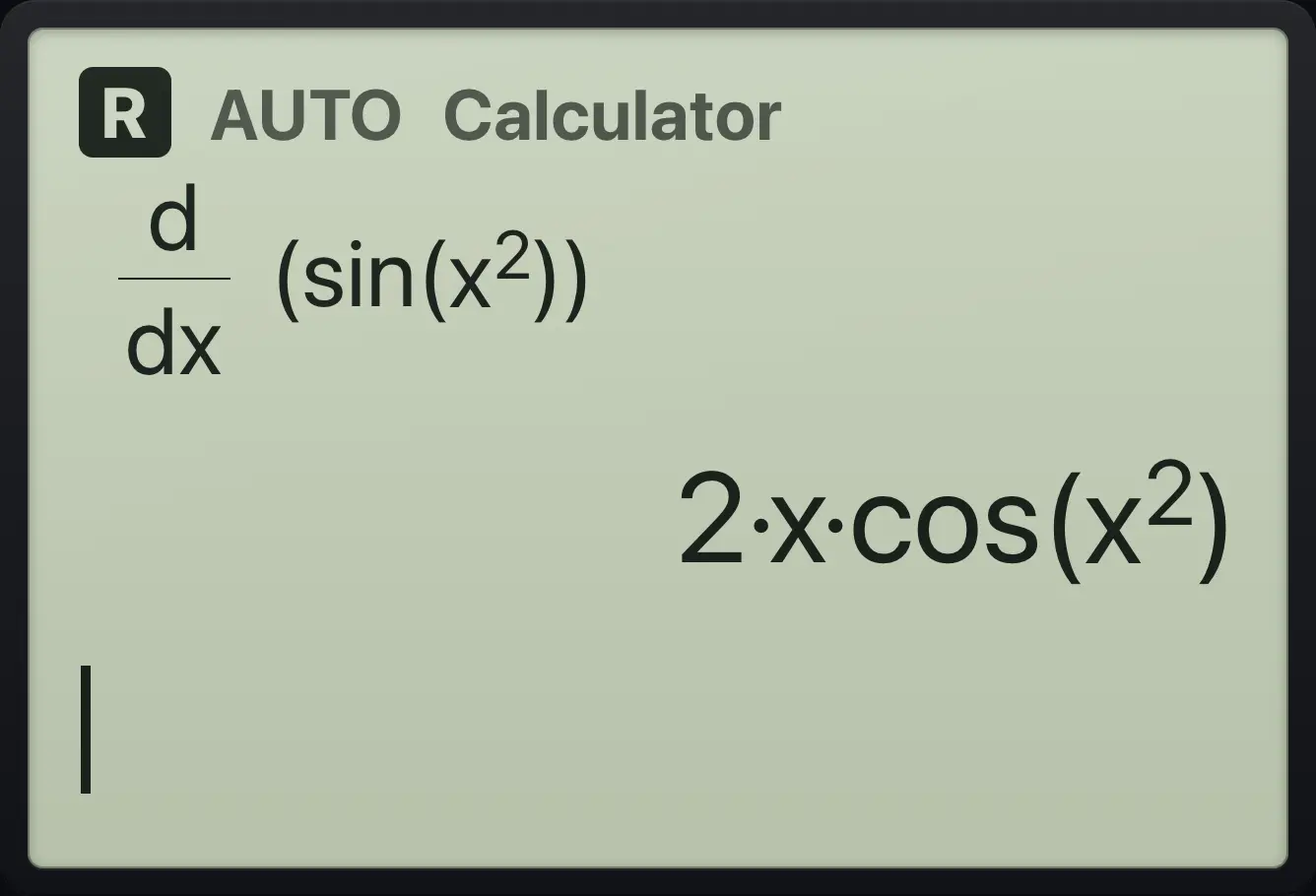
Result of the example "Derivative of sin(x²)" The display shows: d/dx(sin(x^2)) / 2·x·cos(x^2).
You should see2·x·cos(x^2)
Example 10.2

Product rule

  1. Choose the derivative template and enter x·eˣ.

    templates8x▶x×e^xenter
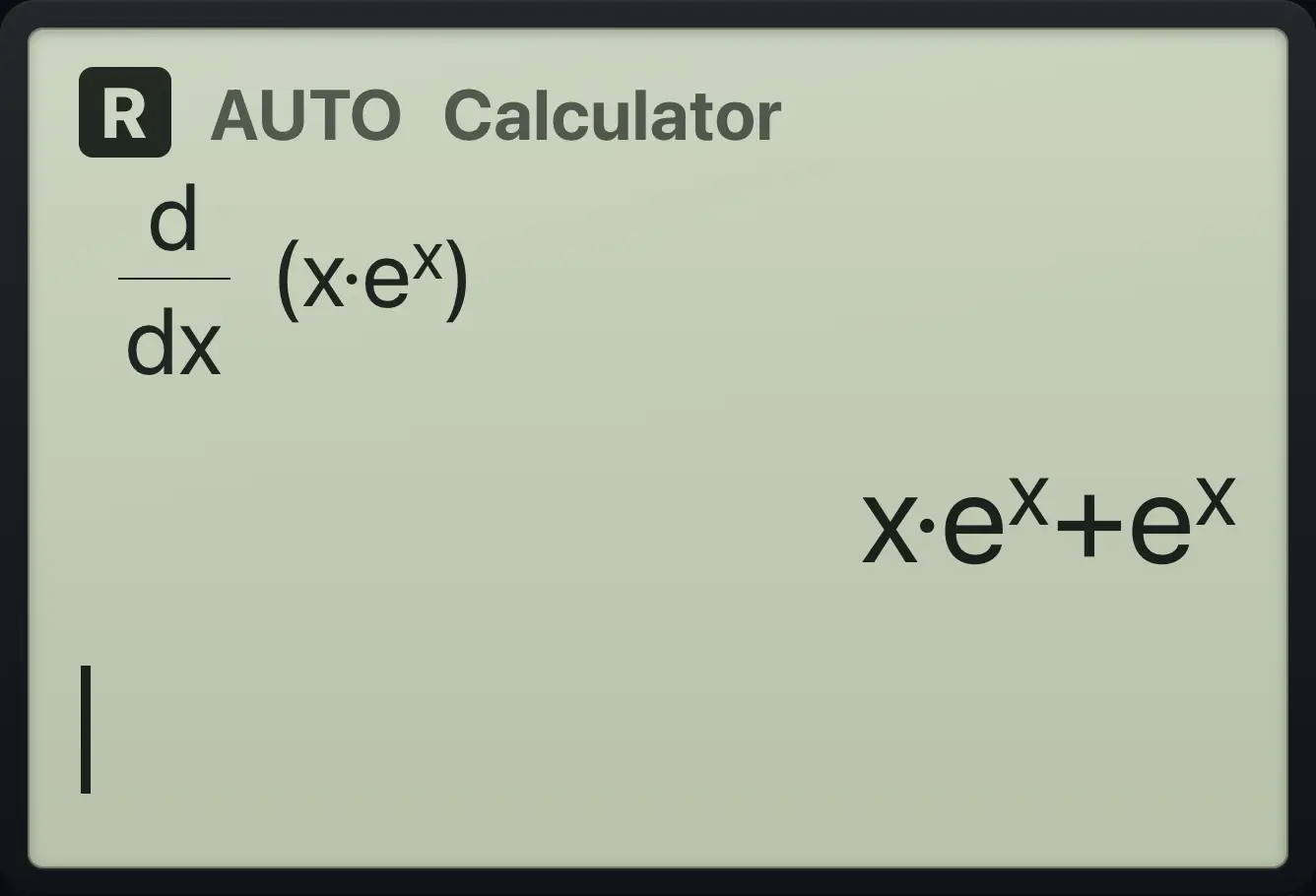
Result of the example "Product rule" The display shows: d/dx(x·e^x) / x·e^x+e^x.
You should seex·e^x+e^x
Example 10.3

Quotient

  1. Differentiate ln(x)/x.

    templates8x▶ln(x)÷xenter
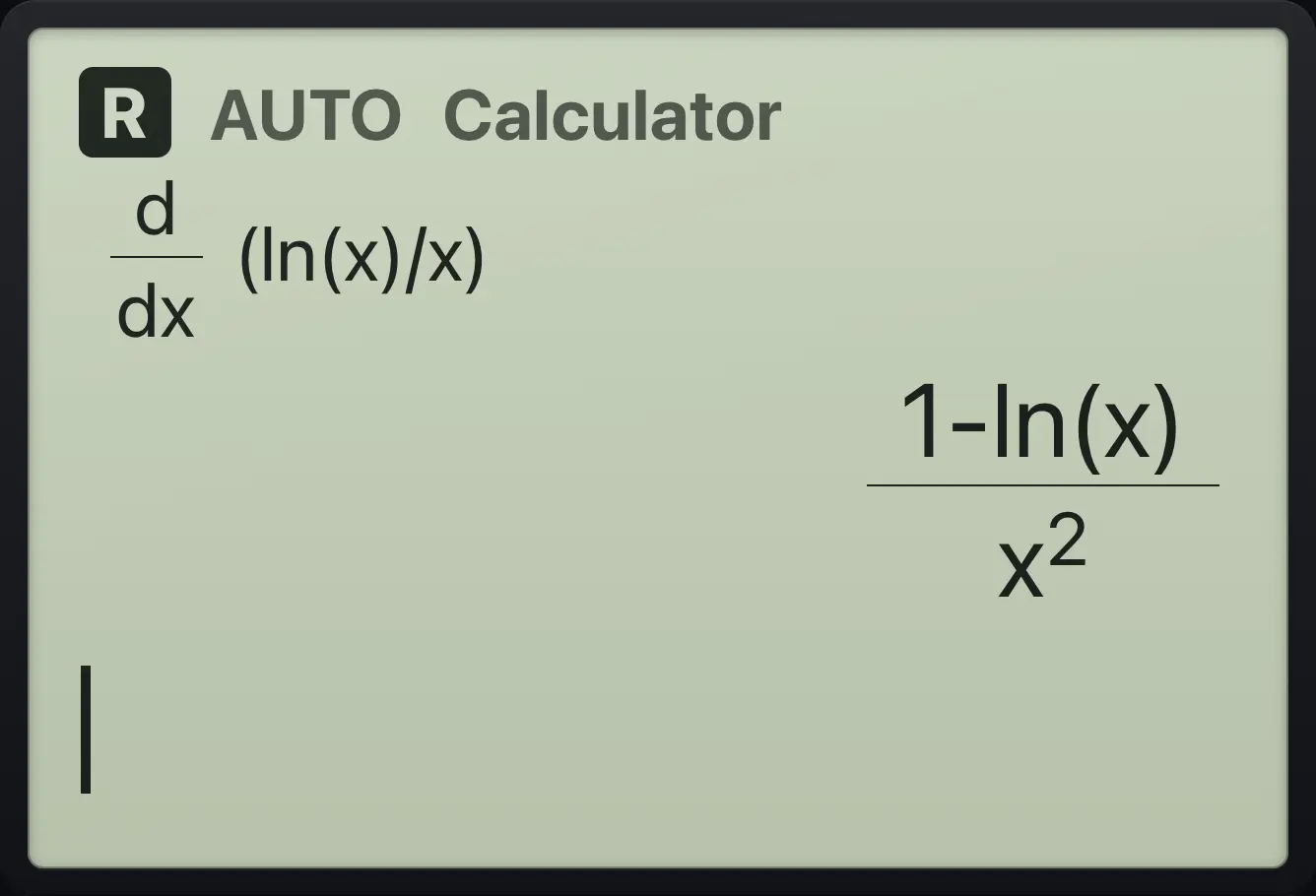
Result of the example "Quotient" The display shows: d/dx(ln(x)/x) / (1-ln(x))/x^2.
You should see(1-ln(x))/x^2
Example 10.4

Derivative from the Calculus menu

  1. Press menu, 4, 1; type x, right, x^3.

    menu41x▶x^3enter
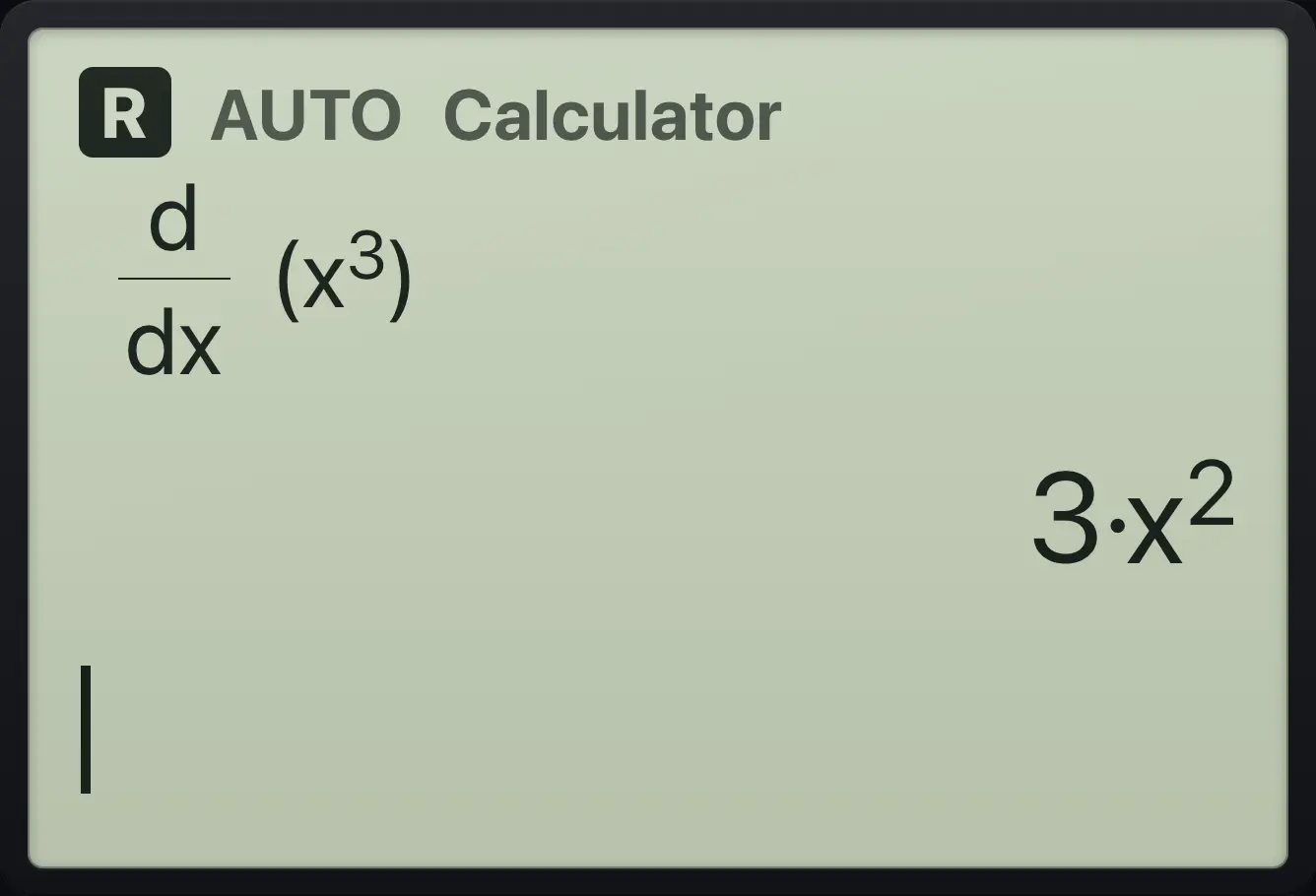
Result of the example "Derivative from the Calculus menu" The display shows: d/dx(x^3) / 3·x^2.
You should see3·x^2
Example 10.5

Second derivative by typing

d2dx2x5=20x3\frac{d^{2}}{dx^{2}}x^{5}=20x^{3}
  1. Type d(x^5, x, 2).

    d(x^5▶,x,2)enter
Result of the example "Second derivative by typing" The display shows: d(x^5,x,2) / 20·x^3.
You should see20·x^3
Example 10.6

Partial derivative

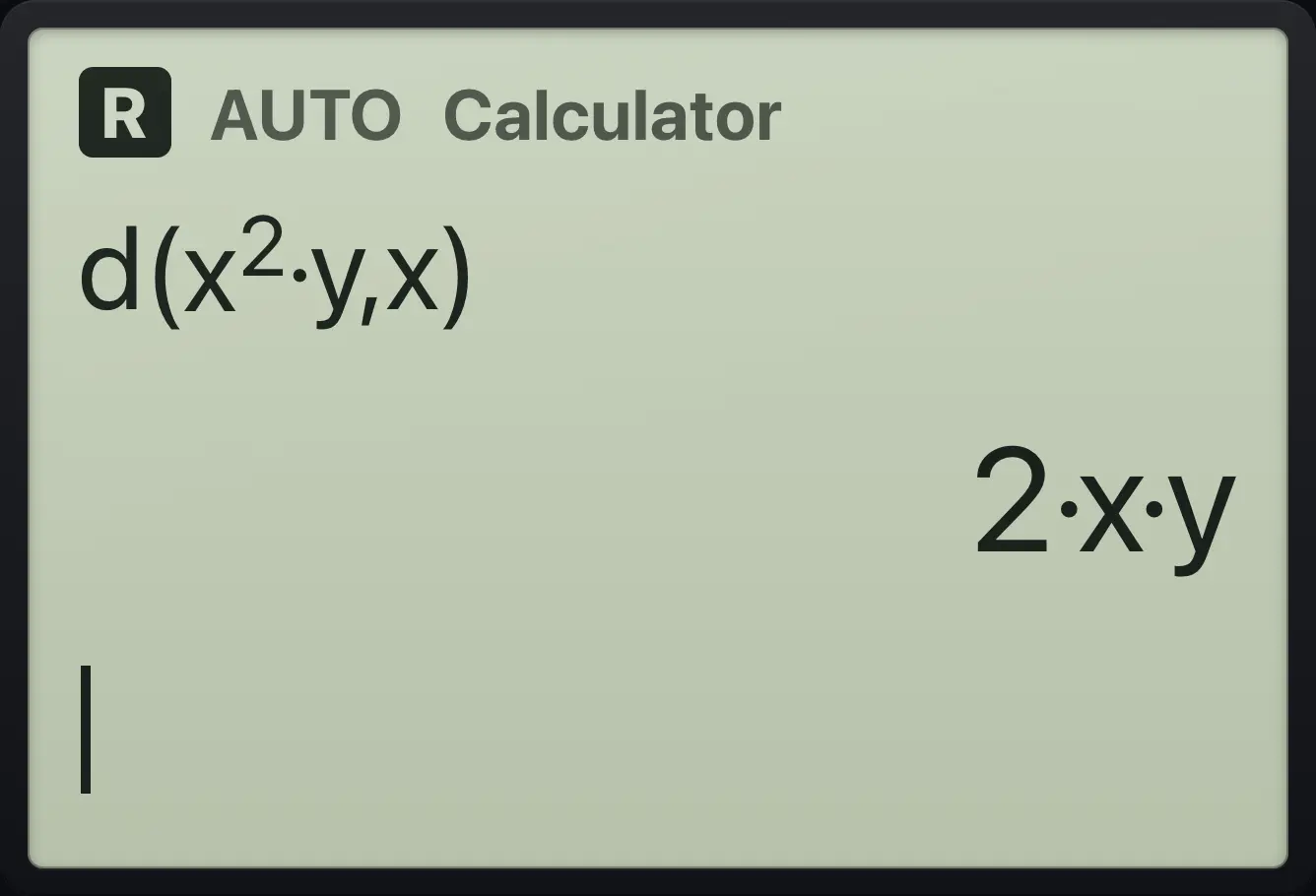
  1. Type d(x²y, x).

    d(x^2▶×y,x)enter
Result of the example "Partial derivative" The display shows: d(x^2·y,x) / 2·x·y.
You should see2·x·y
Example 10.7

Implicit derivative

x2+y2=25⇒dydx=−xyx^{2}+y^{2}=25\Rightarrow\frac{dy}{dx}=-\frac{x}{y}
  1. Type impDif(x²+y²=25, x, y).

    impdif(x^2▶+y^2▶=25,x,y)enter
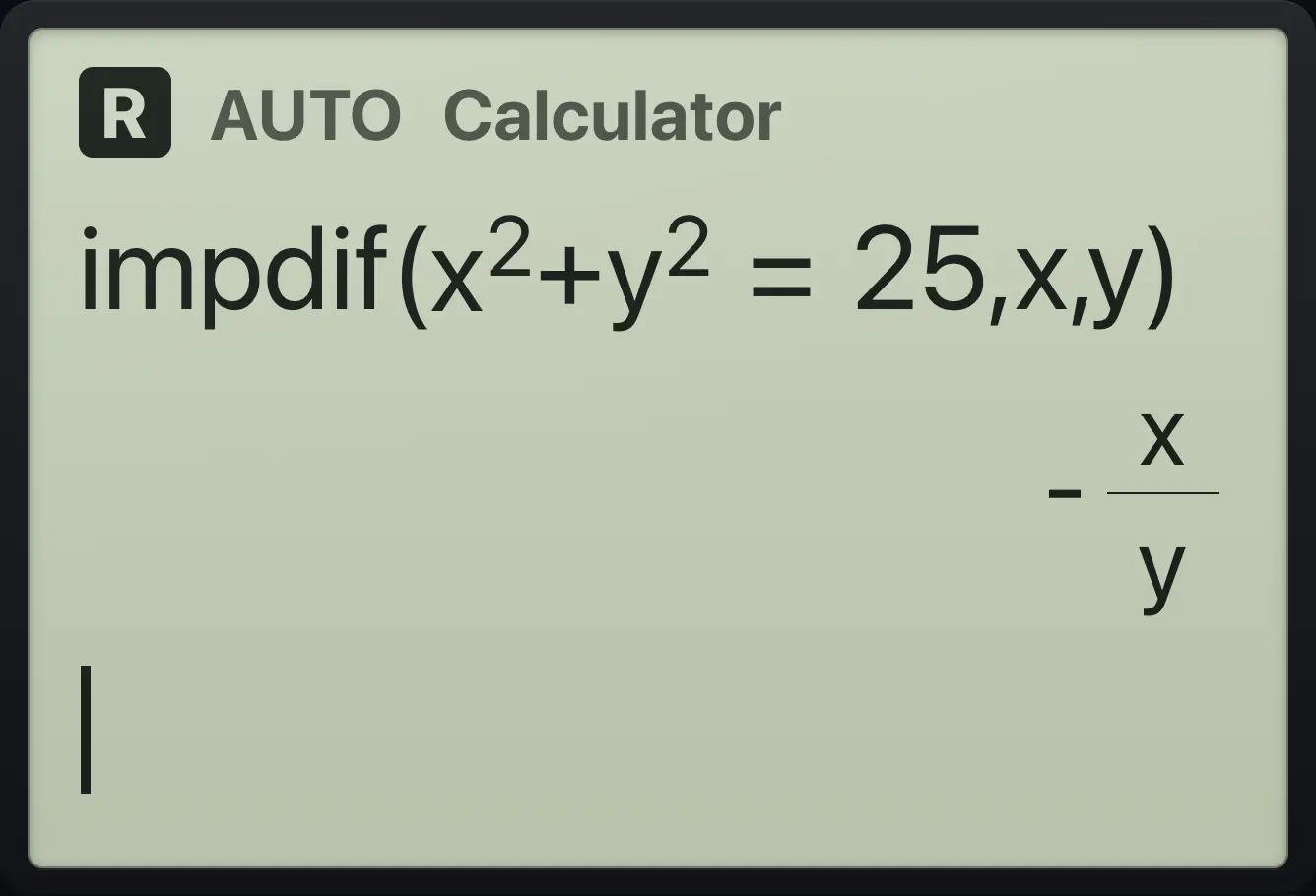
Result of the example "Implicit derivative" The display shows: impdif(x^2+y^2=25,x,y) / -x/y.
You should see-x/y

10.2Find an integral#

Choose Integral (templates, 9). Type the expression, move right out of any power, then to the variable box. No "+ C" is shown: the answer is one antiderivative.

Example 10.8

Antiderivative of x²

∫x2 dx=x33\int x^{2}\,dx=\frac{x^{3}}{3}
  1. Choose the integral template, type x², press right twice, type x.

    templates9x^2▶▶xenter
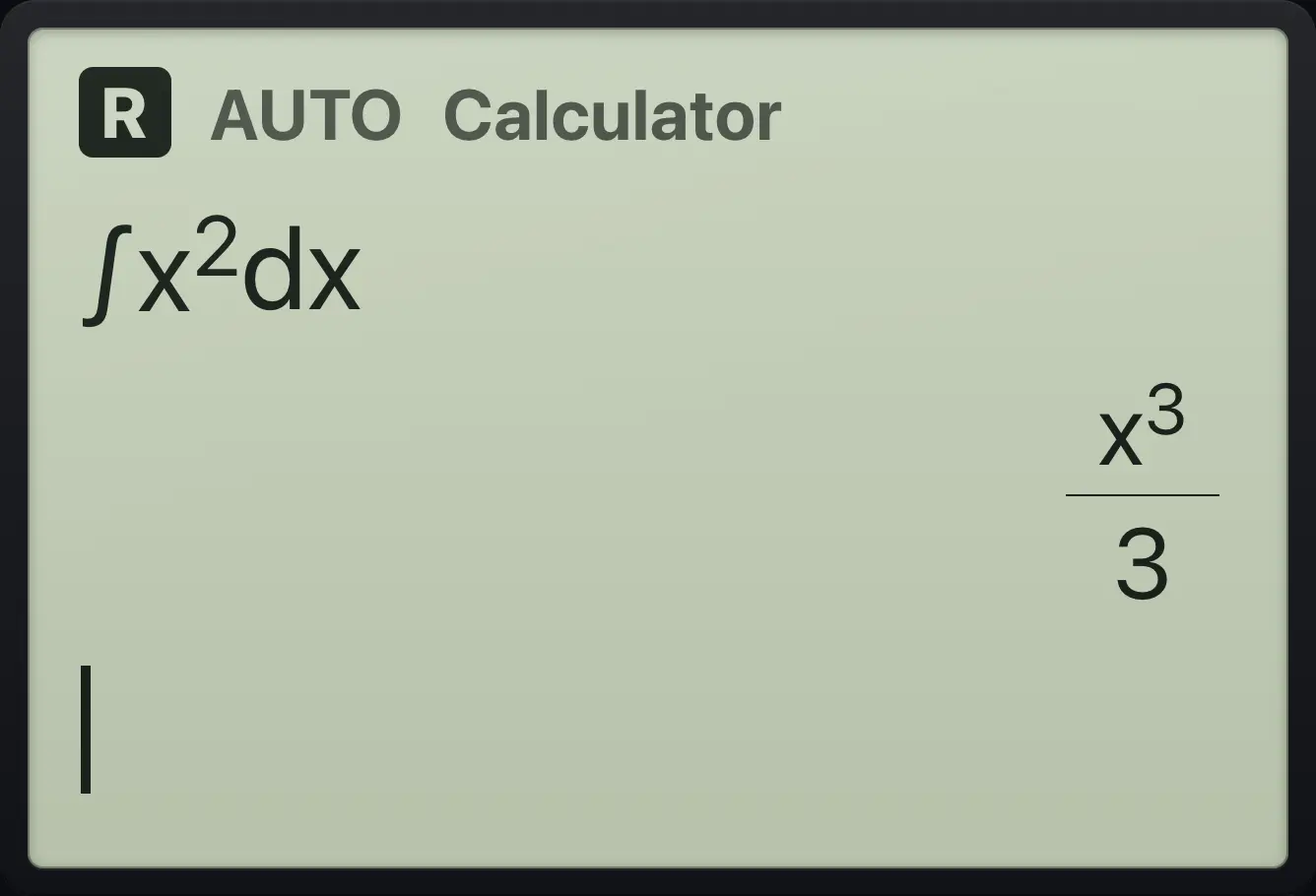
Result of the example "Antiderivative of x²" The display shows: ∫(x^2)dx / x^3/3.
You should seex^3/3
Example 10.9

Integration by parts

∫xex dx=(x−1)ex\int xe^{x}\,dx=(x-1)e^{x}
  1. Integrate x·eˣ.

    templates9x×e^x▶▶xenter
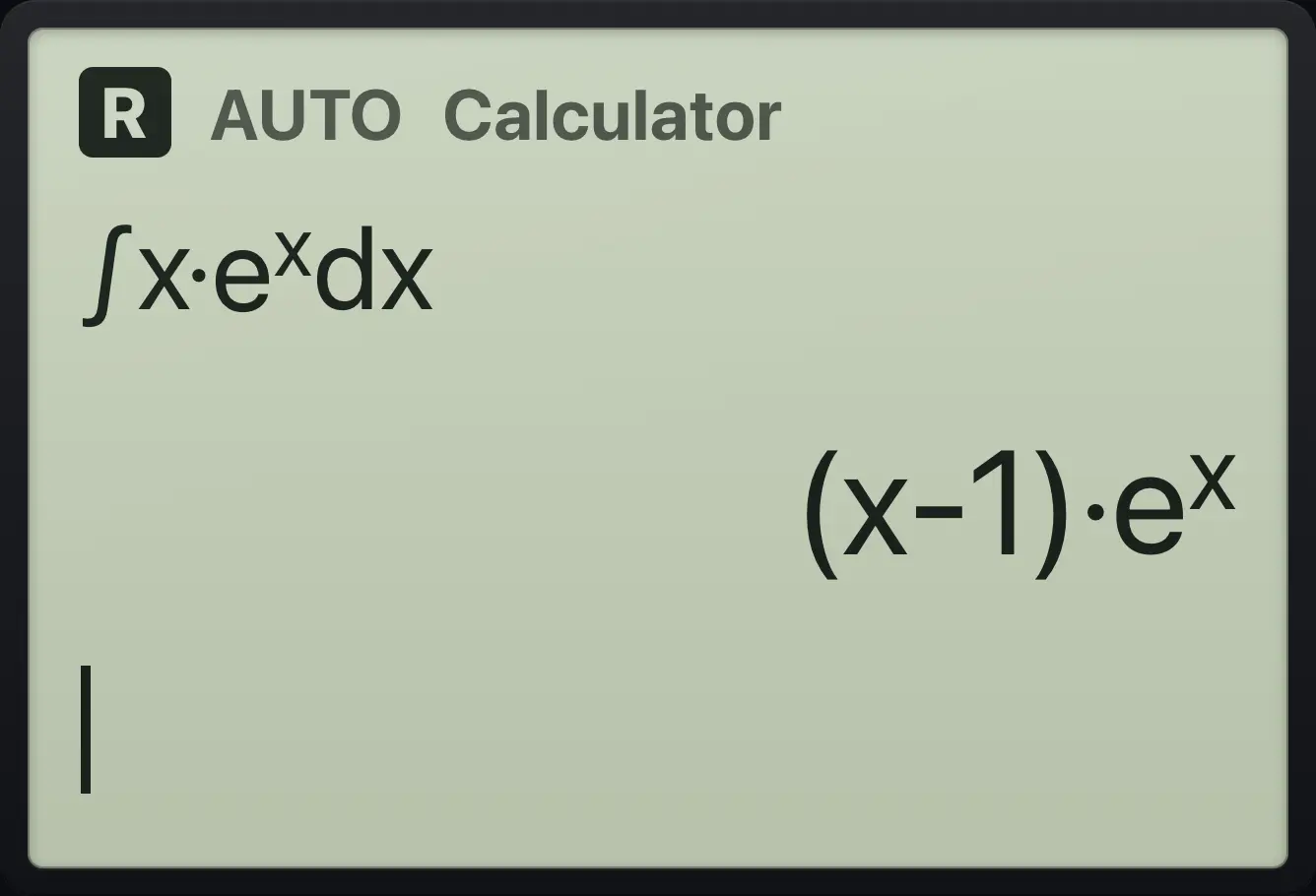
Result of the example "Integration by parts" The display shows: ∫(x·e^x)dx / (x-1)·e^x.
You should see(x-1)·e^x
Example 10.10

Integral of ln x

  1. Integrate ln(x).

    templates9ln(x)▶xenter
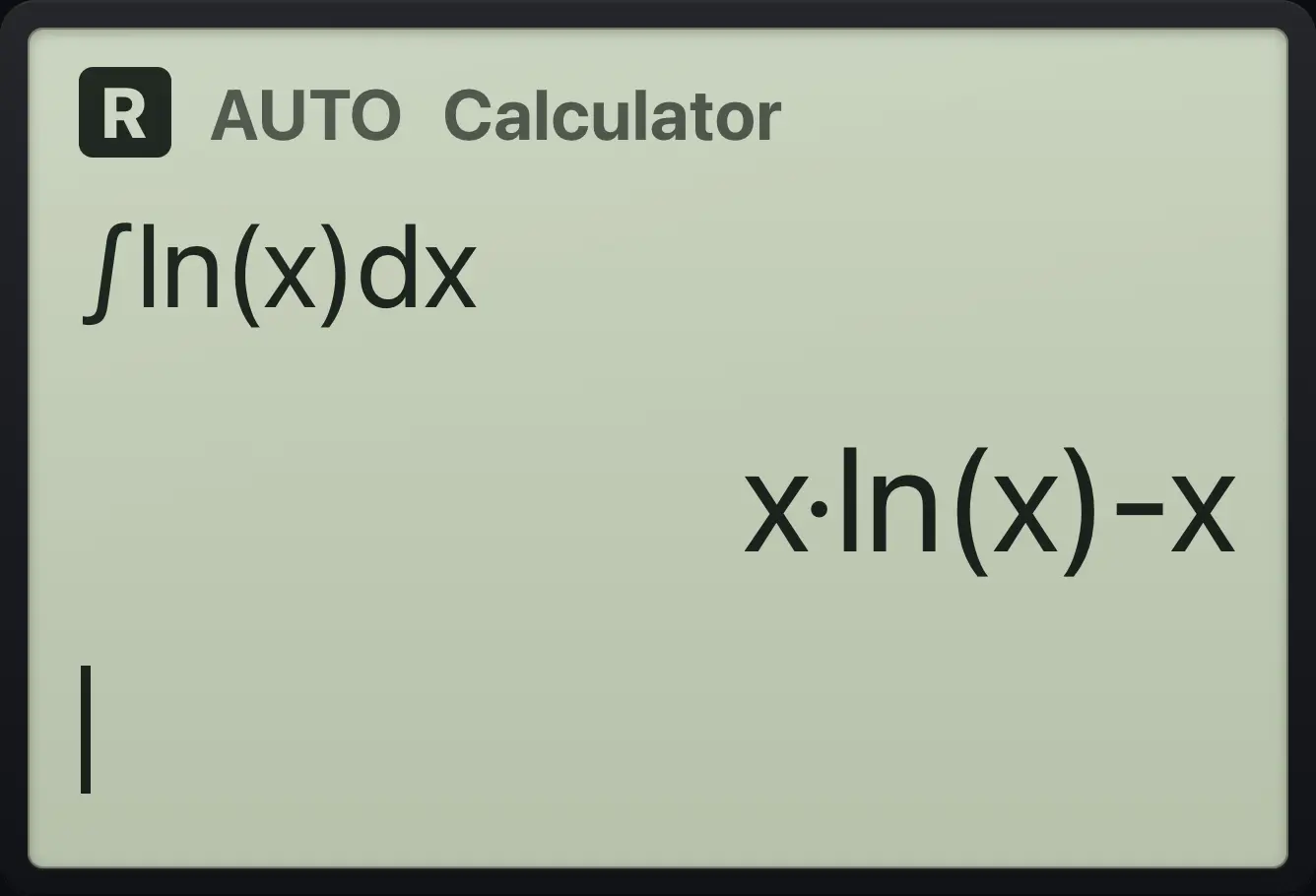
Result of the example "Integral of ln x" The display shows: ∫(ln(x))dx / x·ln(x)-x.
You should seex·ln(x)-x
Example 10.11

Trig squared

  1. Integrate cos(x)².

    templates9cos(x)^2▶▶xenter
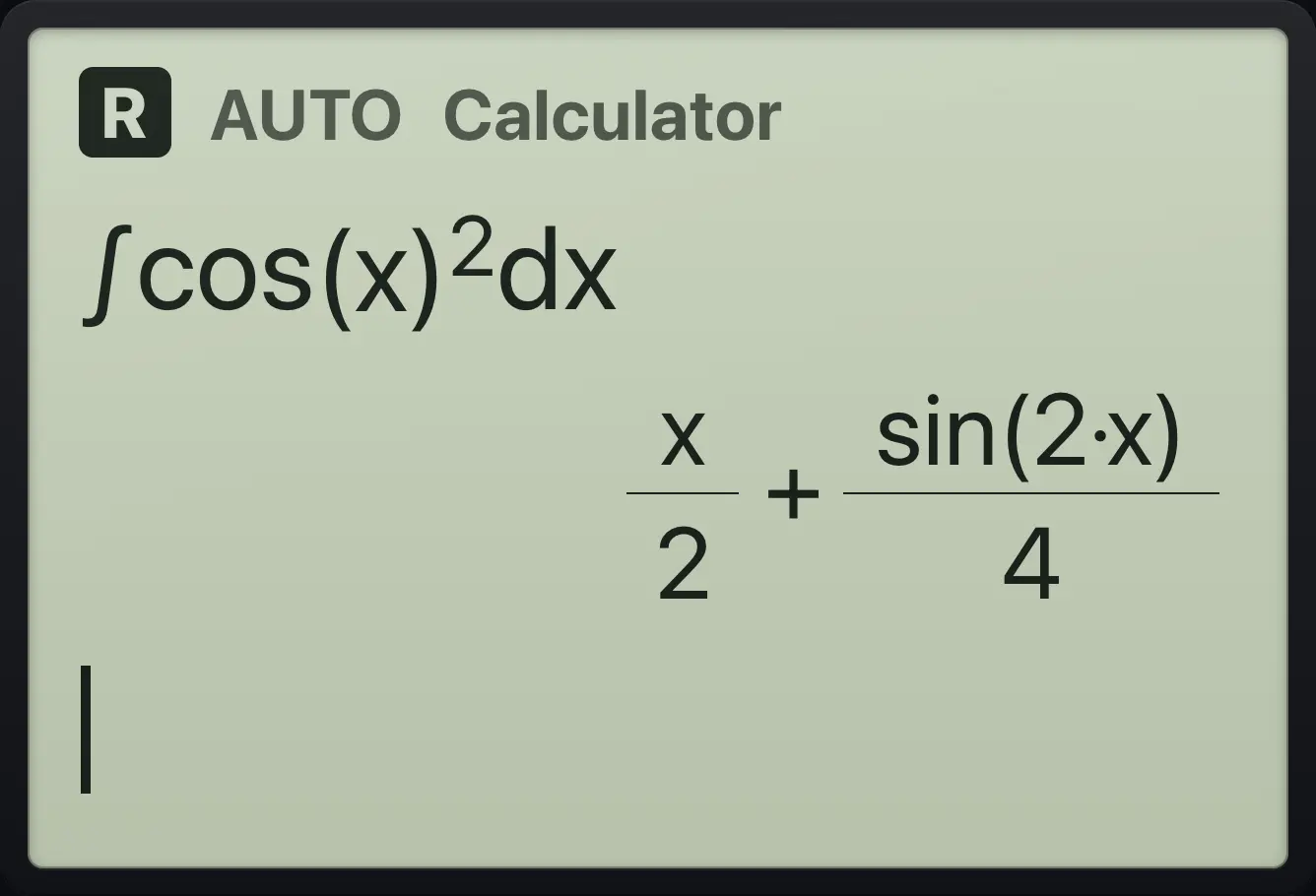
Result of the example "Trig squared" The display shows: ∫(cos(x)^2)dx / x/2+sin(2·x)/4.
You should seex/2+sin(2·x)/4
Example 10.12

Integral by typing

  1. Type integral(x², x).

    integral(x^2▶,x)enter
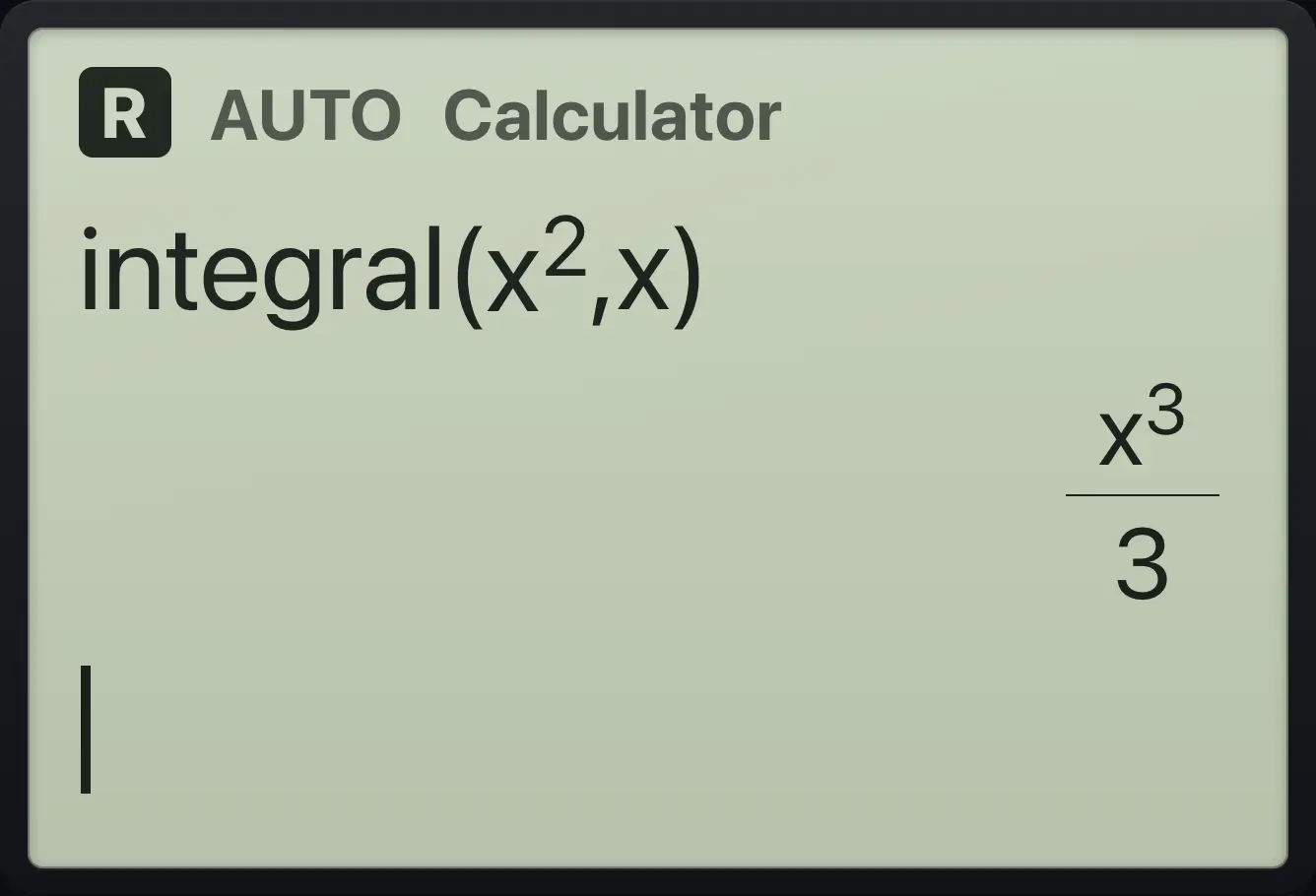
Result of the example "Integral by typing" The display shows: integral(x^2,x) / x^3/3.
You should seex^3/3

10.3Definite and improper integrals#

The definite integral template (templates, A) has four boxes: lower limit, upper limit, expression, variable. Use ∞ (∞) for an improper integral.

Example 10.13

Area under a sine

∫0πsin⁡x dx=2\int_{0}^{\pi}\sin x\,dx=2
  1. Fill 0, π, sin(x), x.

    templatesa0▶π▶sin(x)▶xenter
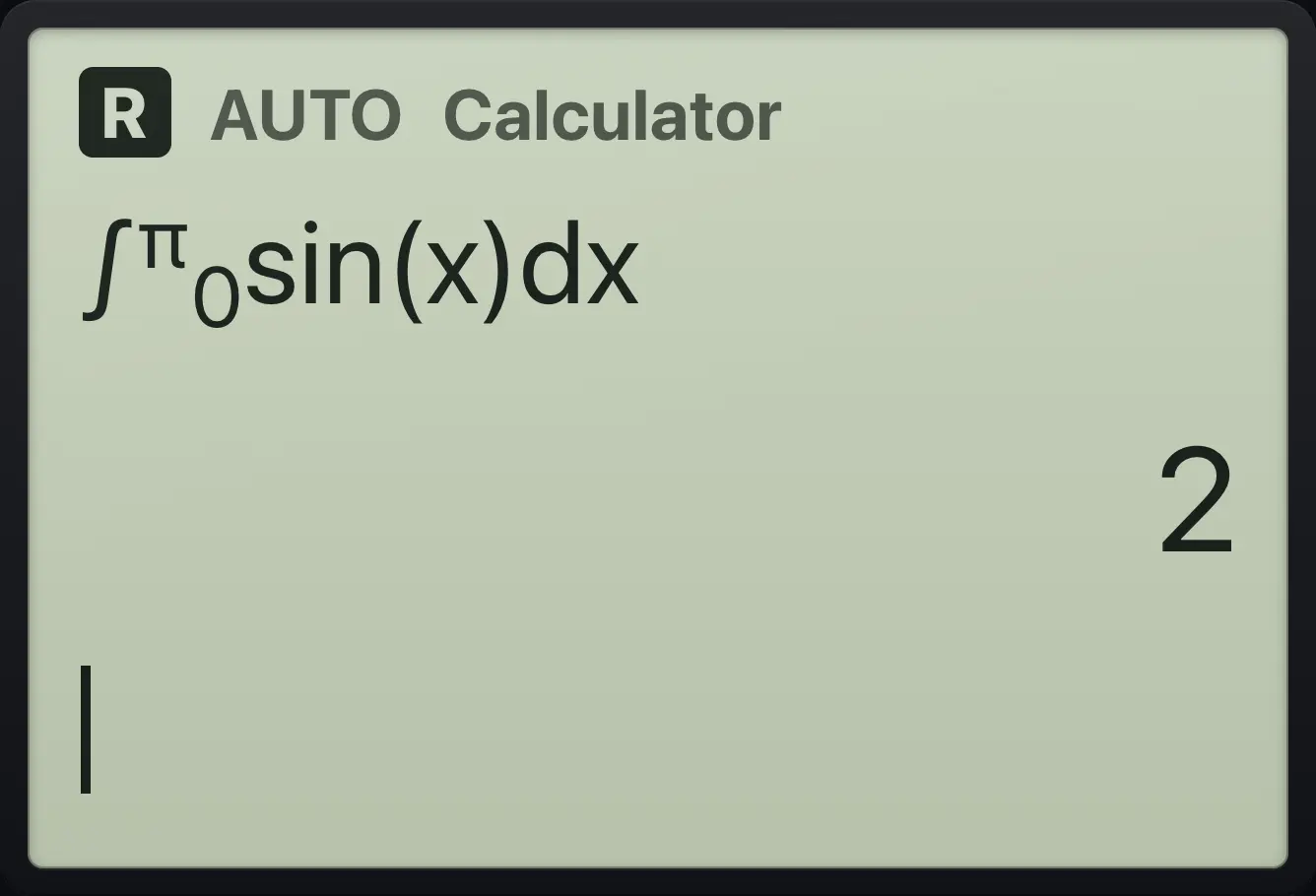
Result of the example "Area under a sine" The display shows: ∫(sin(x),x,0,π) / 2.
You should see2
Example 10.14

Area under a parabola

∫01x2 dx=13\int_{0}^{1}x^{2}\,dx=\frac13
  1. Fill 0, 1, x², x.

    templatesa0▶1▶x^2▶▶xenter
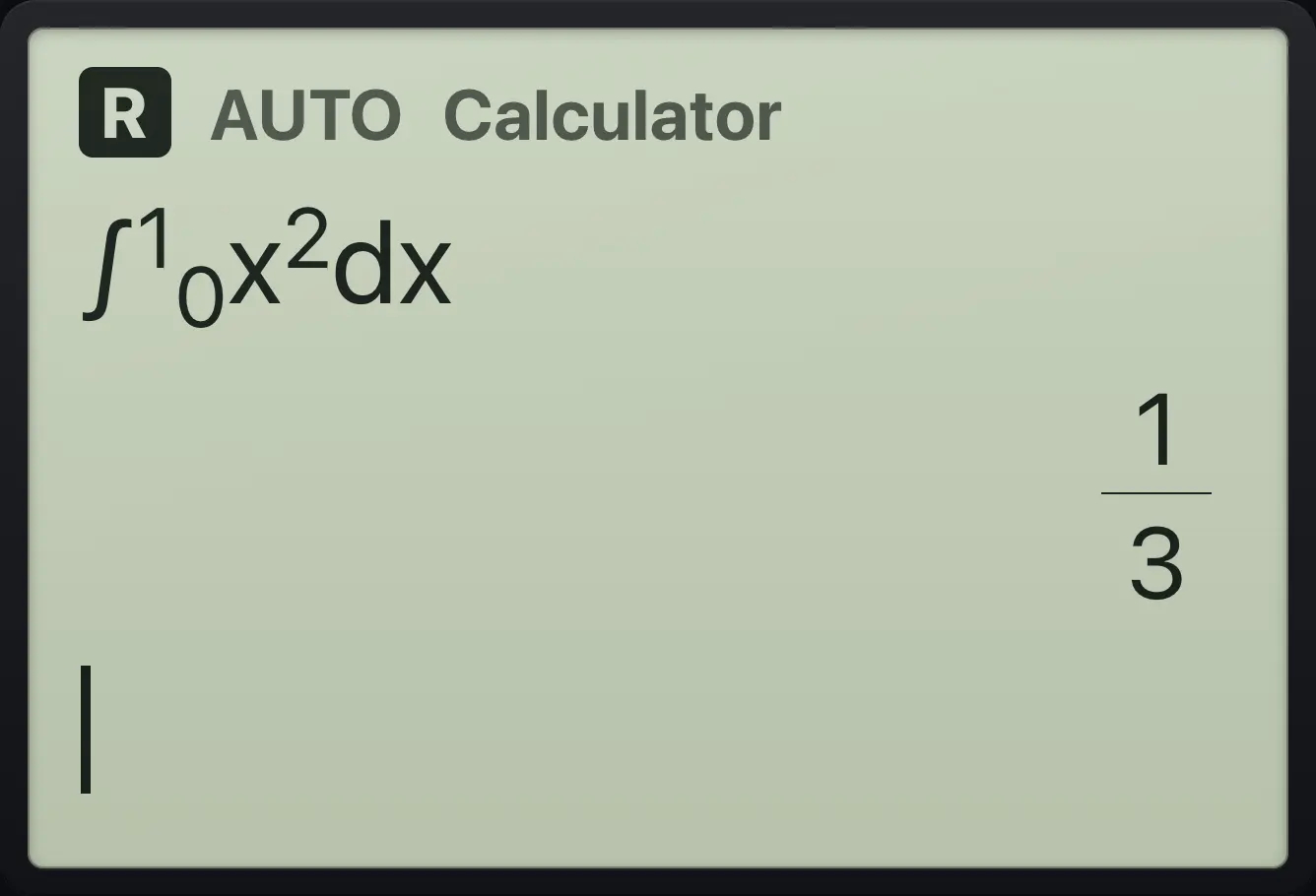
Result of the example "Area under a parabola" The display shows: ∫(x^2,x,0,1) / 1/3.
You should see1/3
Example 10.15

Improper integral

∫1∞1x2 dx=1\int_{1}^{\infty}\frac{1}{x^{2}}\,dx=1
  1. Fill 1, ∞, 1/x², x.

    templatesa1▶∞▶1÷x^2▶▶xenter
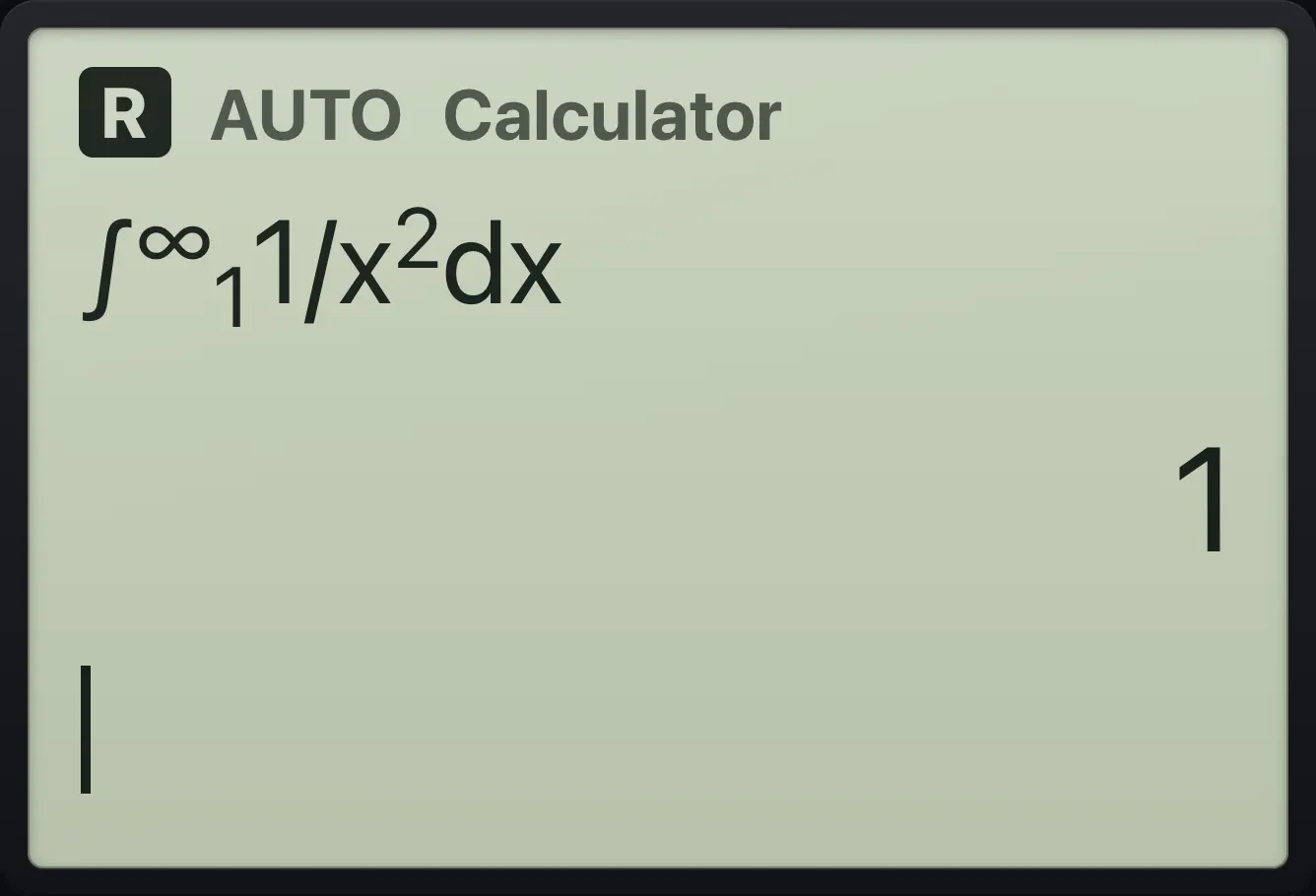
Result of the example "Improper integral" The display shows: ∫(1/x^2,x,1,∞) / 1.
You should see1
Example 10.16

Definite integral by typing

  1. Type integral(x², x, 0, 3).

    integral(x^2▶,x,0,3)enter
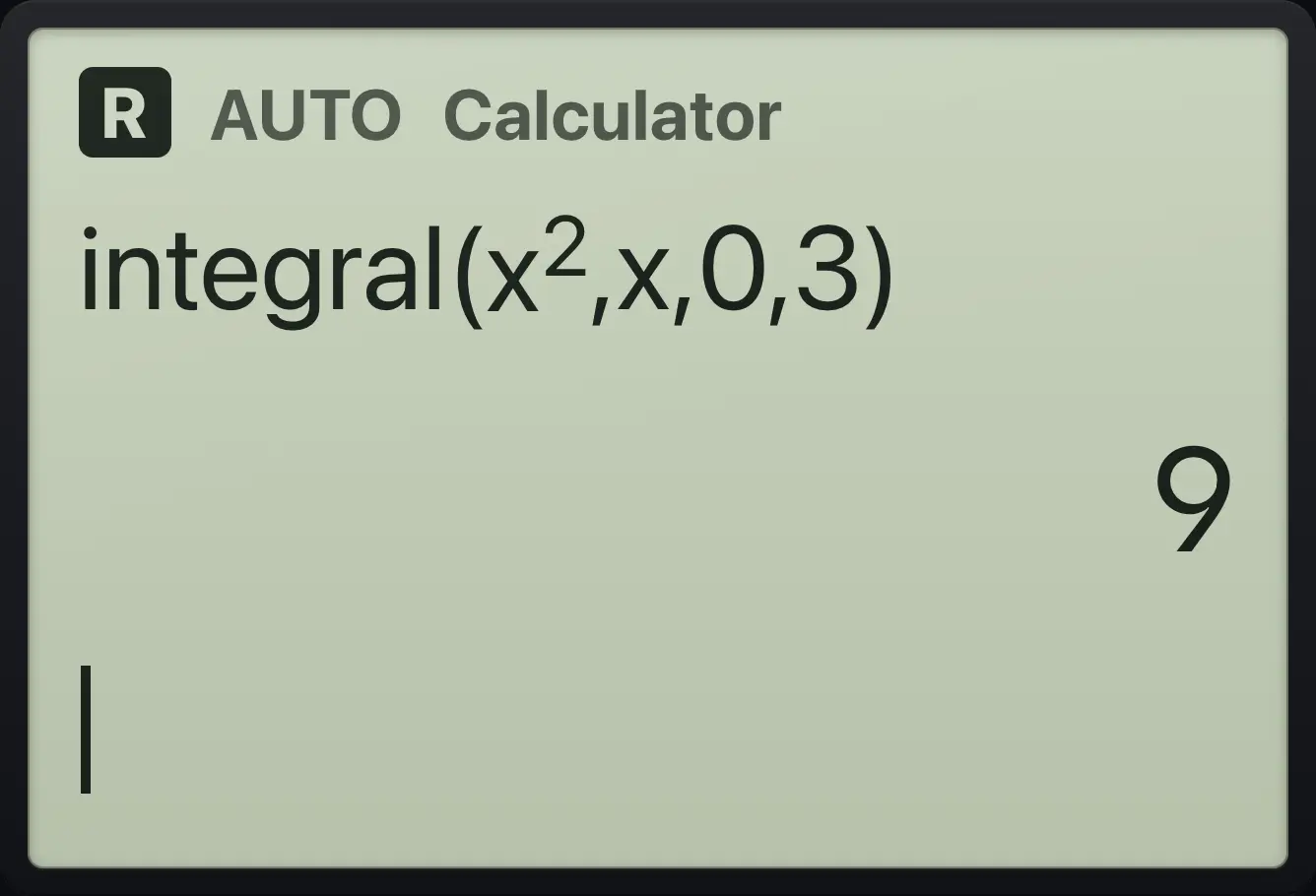
Result of the example "Definite integral by typing" The display shows: integral(x^2,x,0,3) / 9.
You should see9

10.4Find a limit#

The limit template (templates, D) takes the variable, the value it approaches, and the expression. By typing: limit(expression, variable, value). Add a fourth argument 1 for a limit from the right or −1 from the left.

Example 10.17

A classic limit

lim⁡x→0sin⁡xx=1\lim_{x\to 0}\frac{\sin x}{x}=1
  1. Choose the limit template: x, 0, sin(x)/x.

    templatesdx▶0▶sin(x)÷xenter
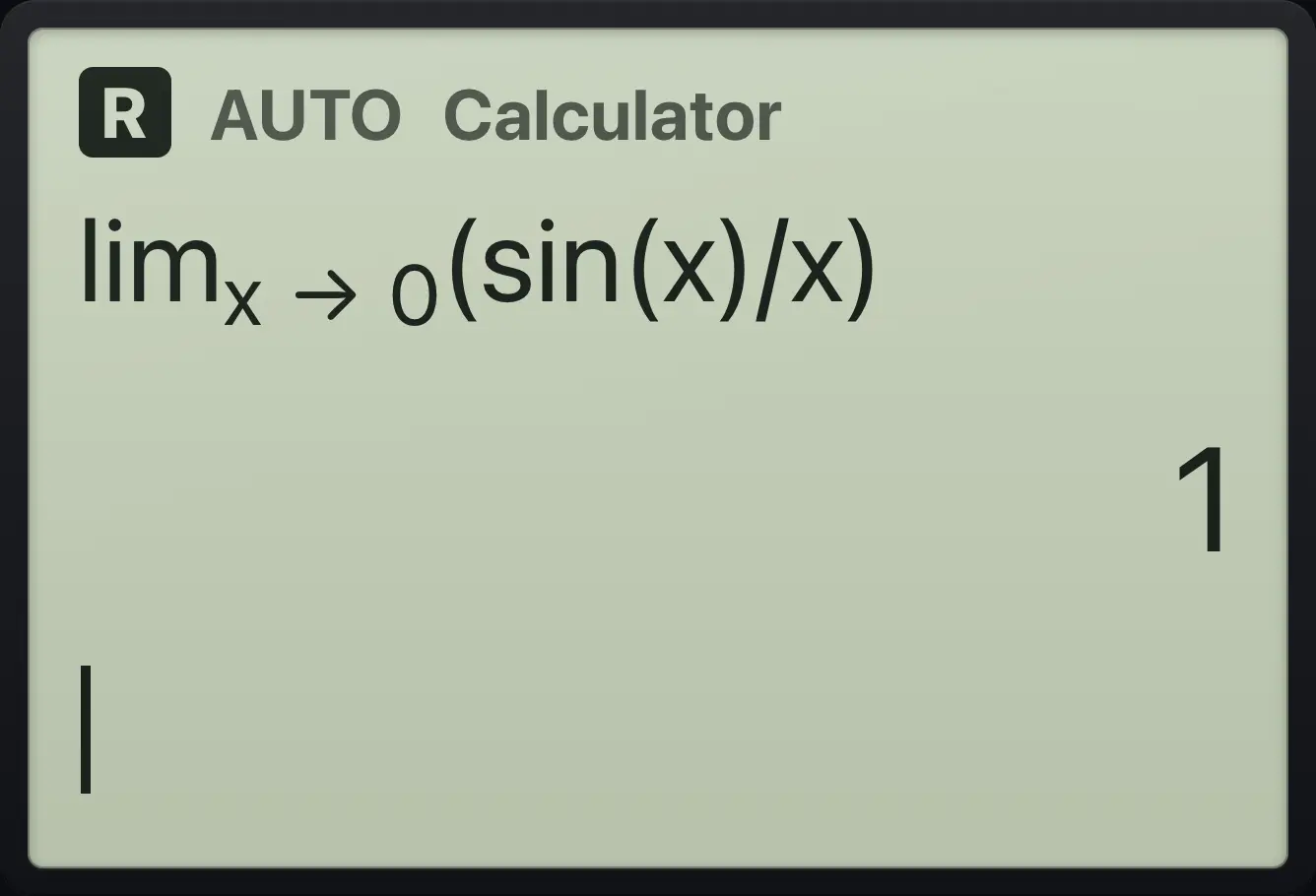
Result of the example "A classic limit" The display shows: lim(sin(x)/x,x,0) / 1.
You should see1
Example 10.18

A limit at infinity

lim⁡n→∞(1+1n)n=e\lim_{n\to\infty}\left(1+\frac1n\right)^{n}=e
  1. Type limit((1+1/n)^n, n, ∞).

    limit((1+1÷n)^n▶,n,∞)enter
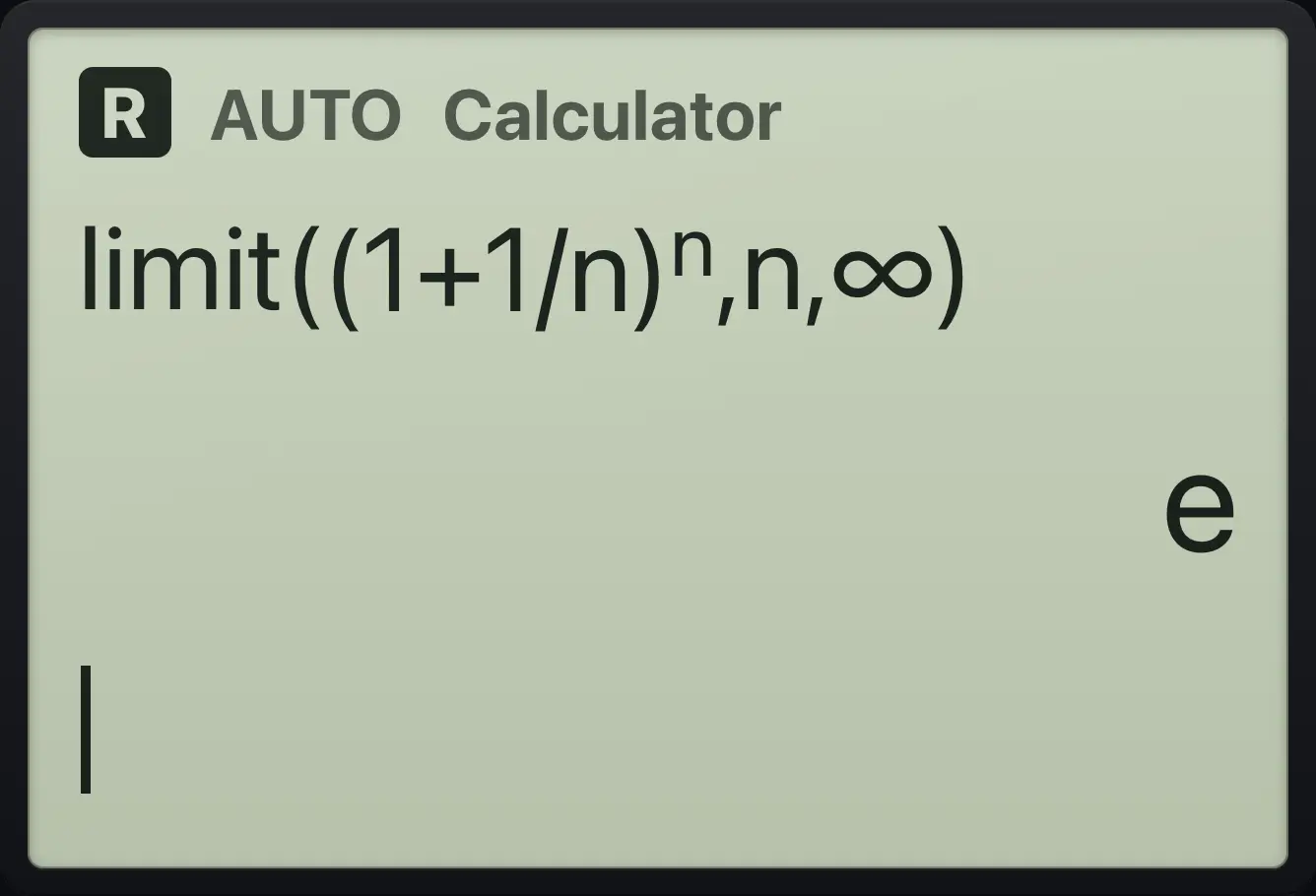
Result of the example "A limit at infinity" The display shows: limit((1+1/n)^n,n,∞) / e.
You should seee
Example 10.19

Cancelling a factor

  1. Type limit((x²−1)/(x−1), x, 1).

    limit((x^2▶−1)÷(x−1),x,1)enter
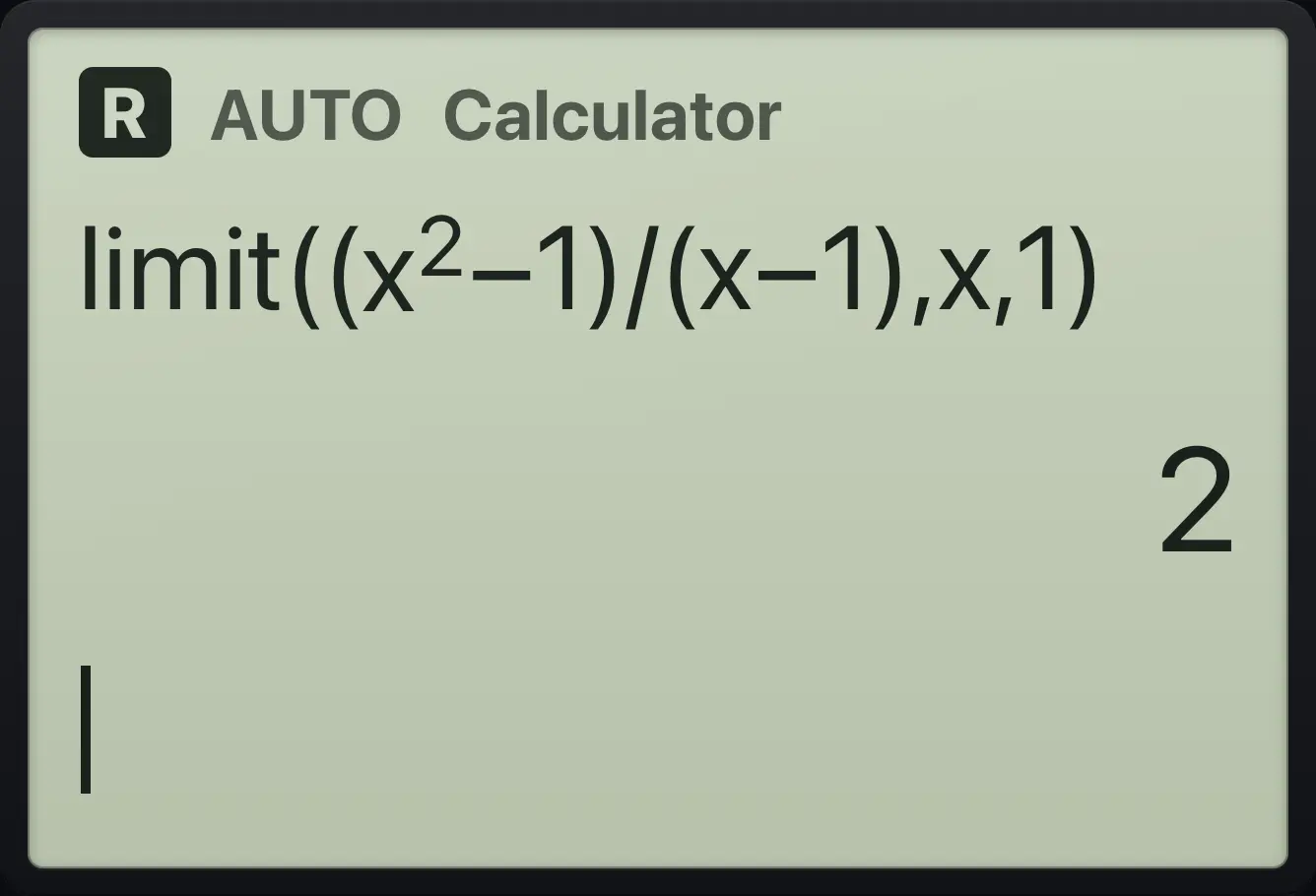
Result of the example "Cancelling a factor" The display shows: limit((x^2−1)/(x−1),x,1) / 2.
You should see2
Example 10.20

One-sided limit from the right

  1. Type limit(1/x, x, 0, 1).

    limit(1÷x,x,0,1)enter
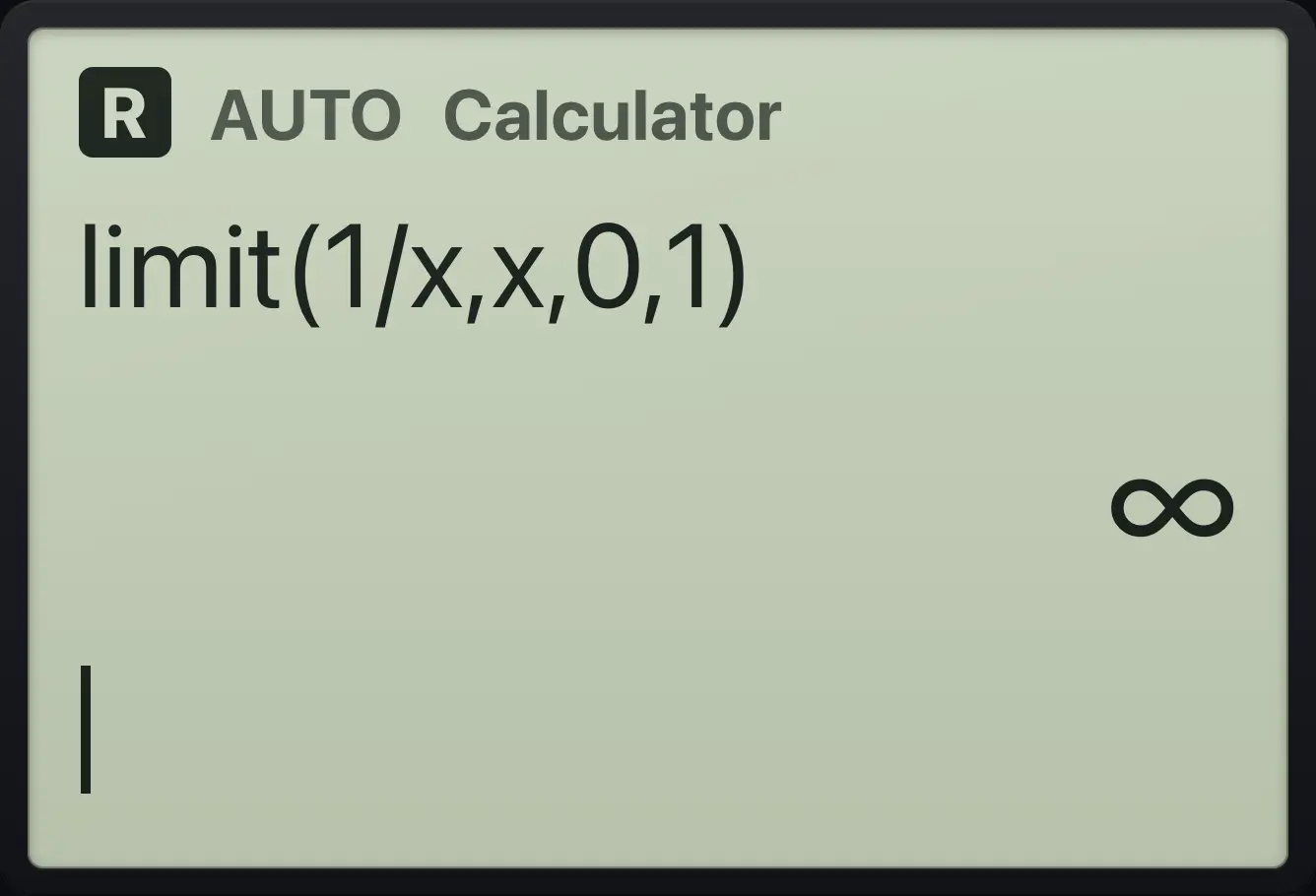
Result of the example "One-sided limit from the right" The display shows: limit(1/x,x,0,1) / ∞.
You should see∞
Example 10.21

One-sided limit from the left

  1. Type limit(1/x, x, 0, −1).

    limit(1÷x,x,0,(−)1)enter
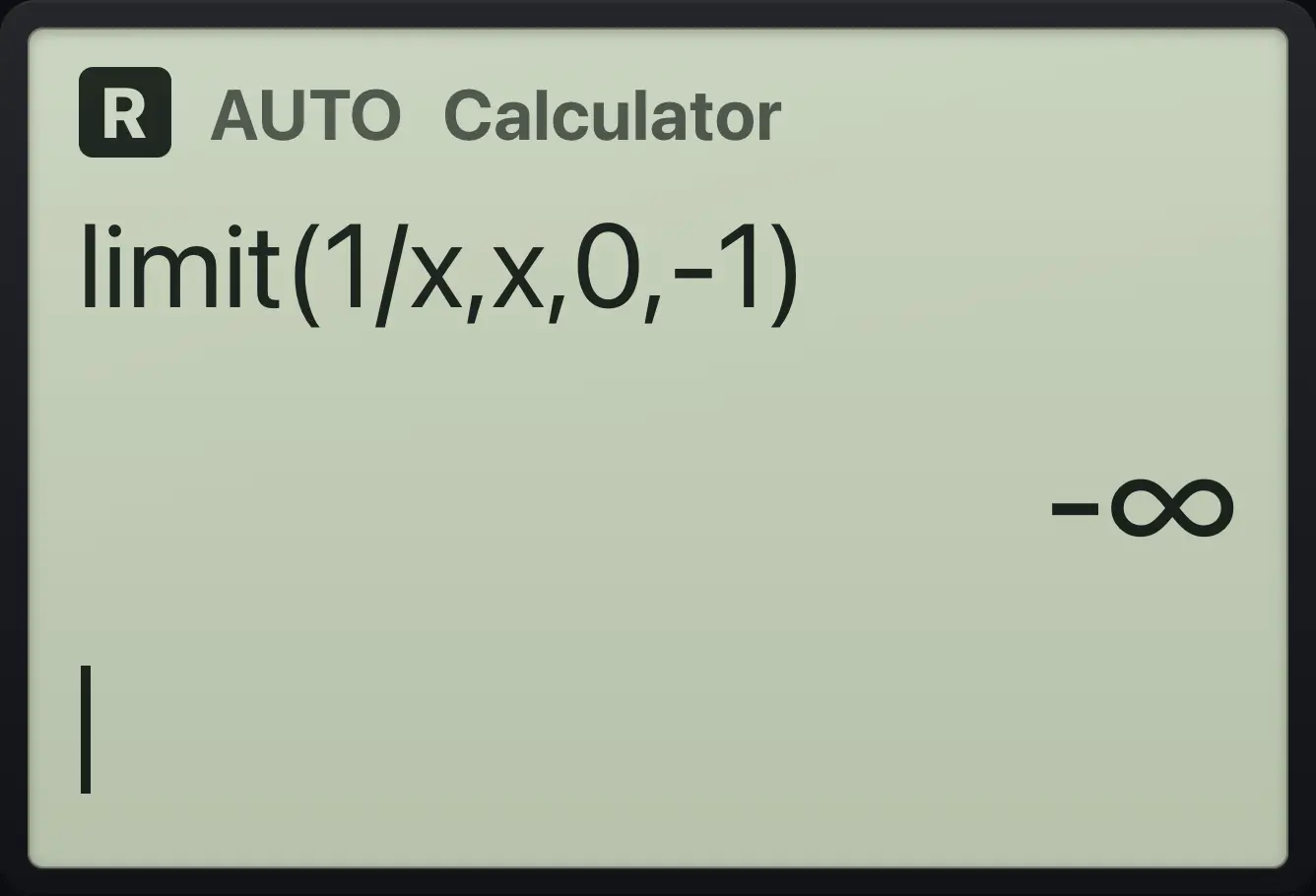
Result of the example "One-sided limit from the left" The display shows: limit(1/x,x,0,-1) / -∞.
You should see-∞
Example 10.22

Two-sided limit that does not exist

  1. Type limit(1/x, x, 0).

    limit(1÷x,x,0)enter
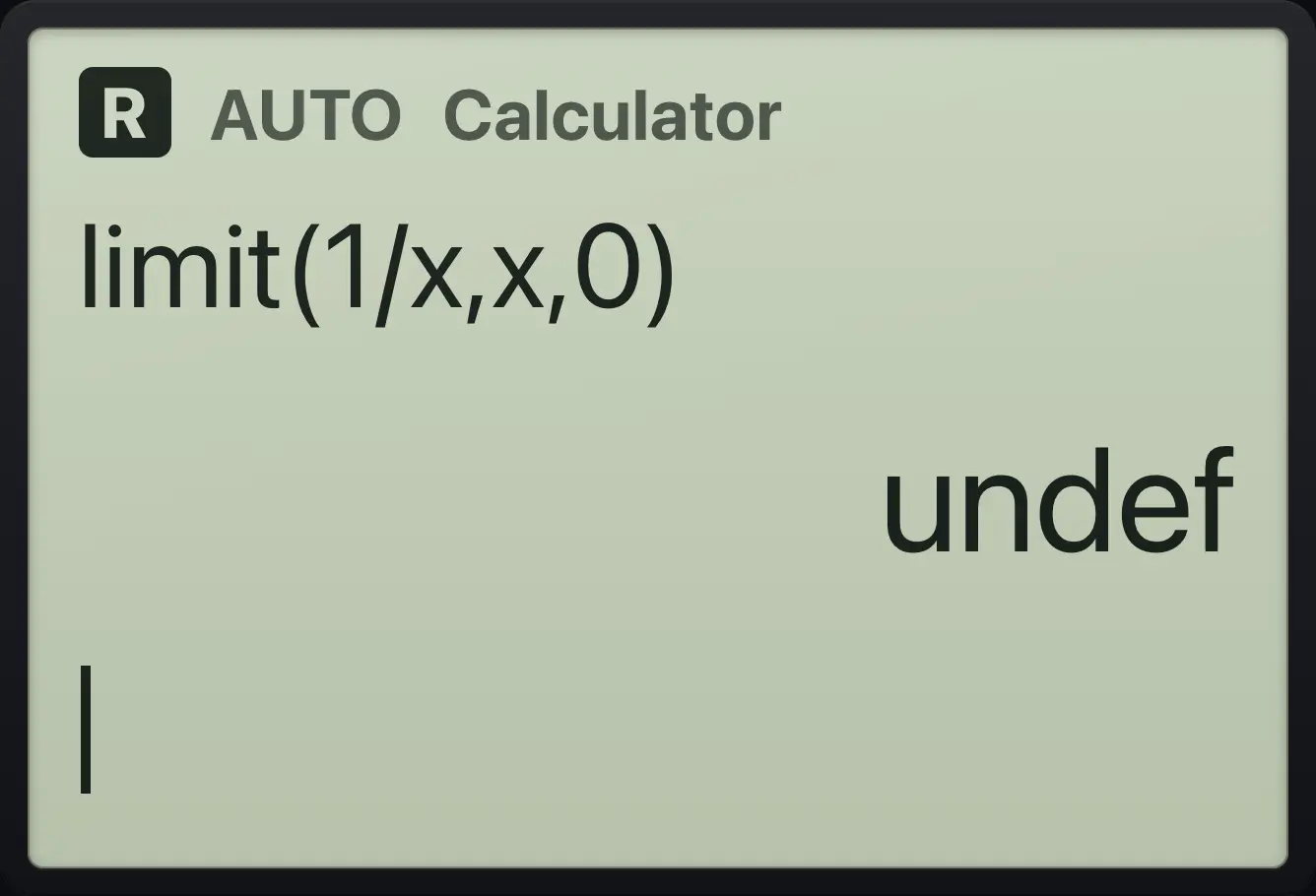
Result of the example "Two-sided limit that does not exist" The display shows: limit(1/x,x,0) / undef.
You should seeundef

10.5Sums and products#

The sum template (templates, B) and product template (templates, C) take the counter, start, end and the expression. Use a letter such as n for a general formula, or ∞ for an infinite sum.

Example 10.23

Sum with a symbolic end

∑k=1nk=n(n+1)2\sum_{k=1}^{n}k=\frac{n(n+1)}{2}
  1. Fill k, 1, n, k.

    templatesbk▶1▶n▶kenter
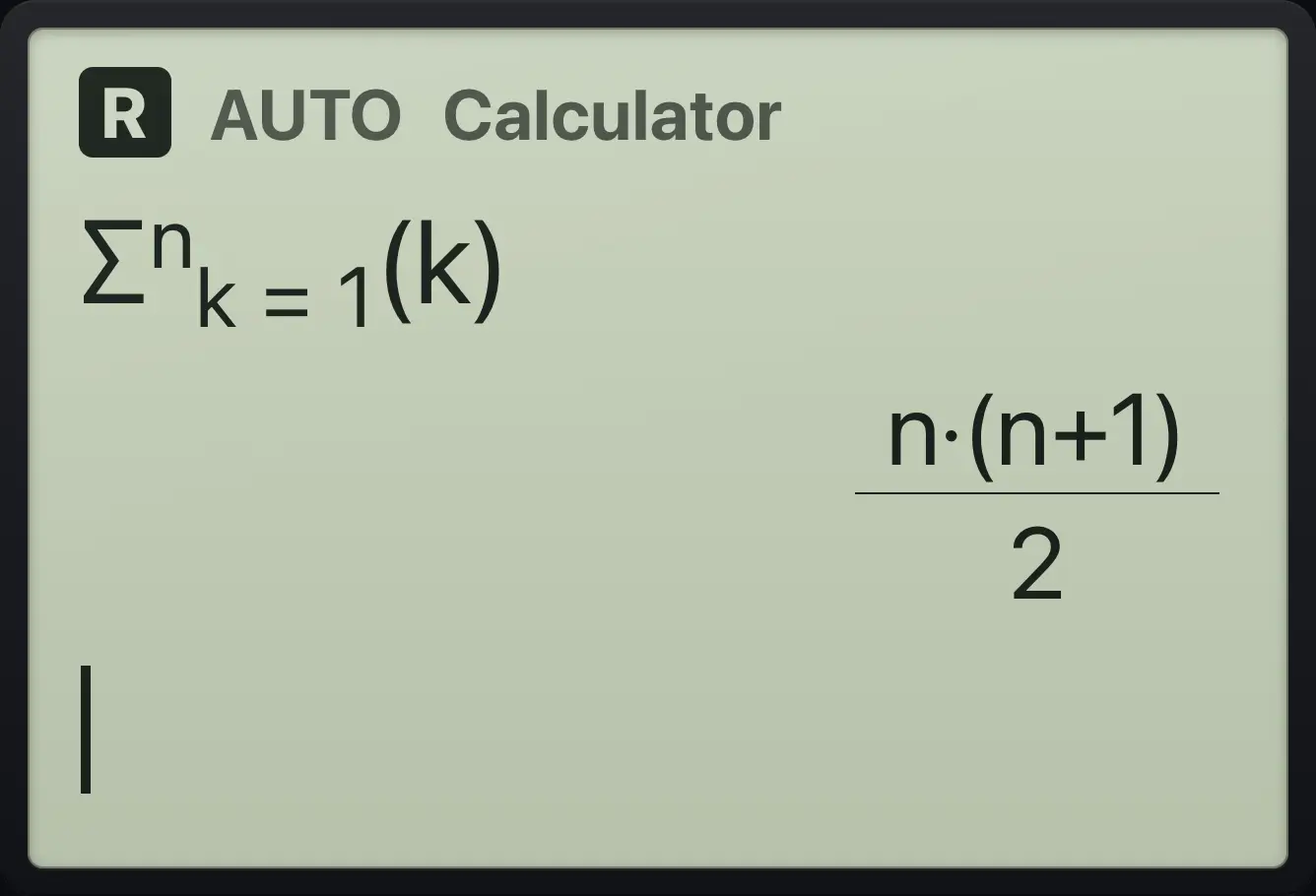
Result of the example "Sum with a symbolic end" The display shows: Σ(k,k,1,n) / n·(n+1)/2.
You should seen·(n+1)/2
Example 10.24

Sum of squares

  1. Fill k, 1, 10, k².

    templatesbk▶1▶10▶k^2▶▶enter
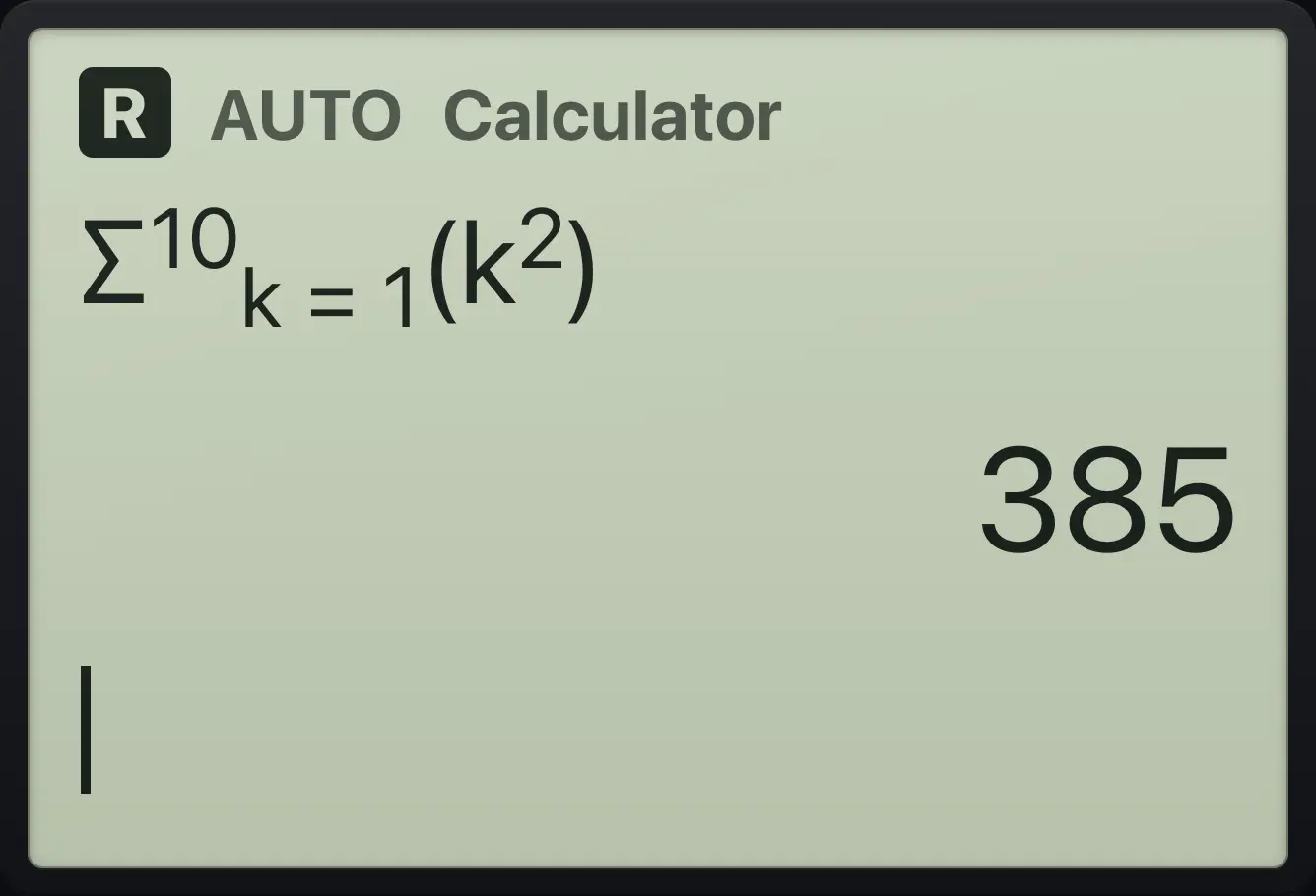
Result of the example "Sum of squares" The display shows: Σ(k^2,k,1,10) / 385.
You should see385
Example 10.25

Product

∏k=15k=120\prod_{k=1}^{5}k=120
  1. Fill k, 1, 5, k.

    templatesck▶1▶5▶kenter
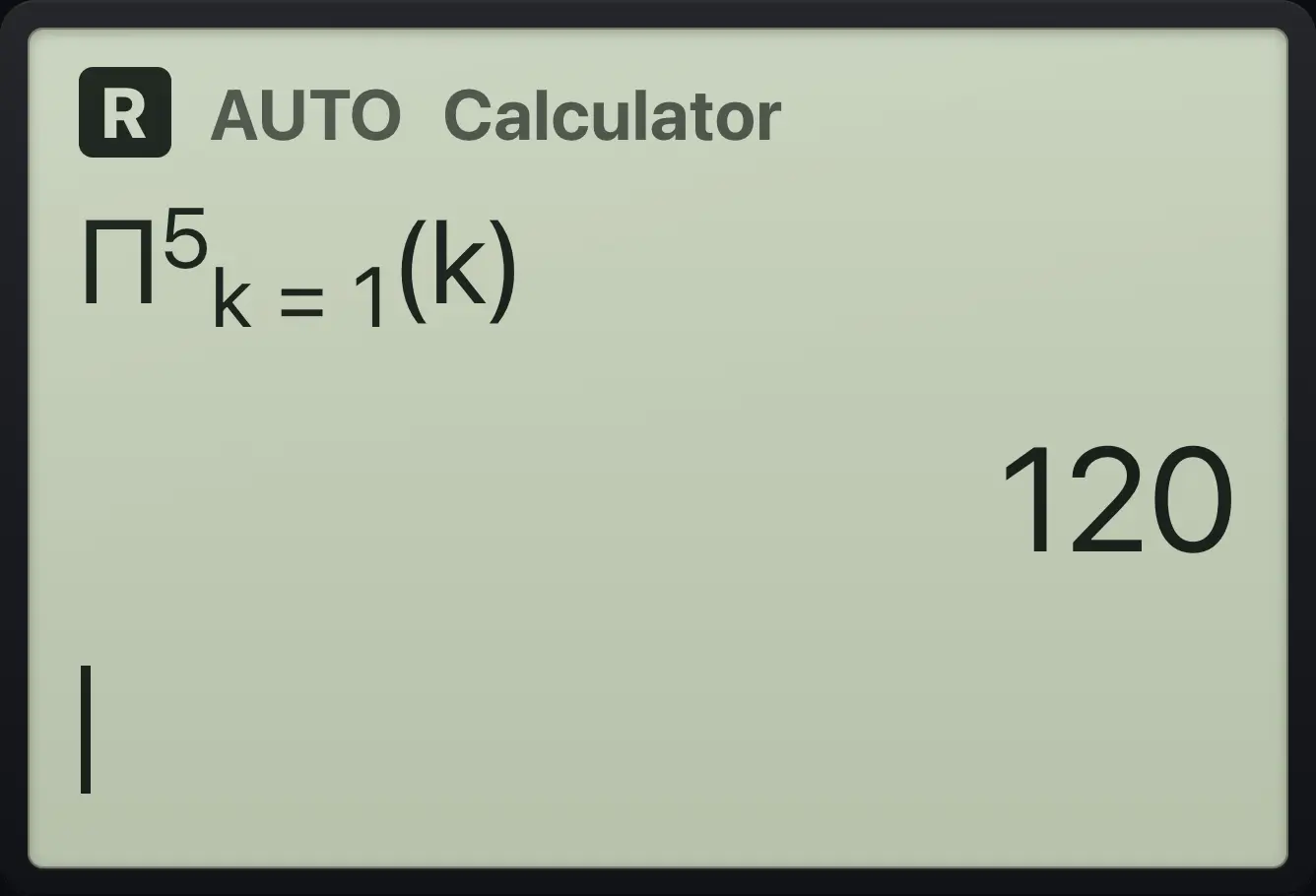
Result of the example "Product" The display shows: Π(k,k,1,5) / 120.
You should see120
Example 10.26

Infinite sum

∑k=0∞(12)k=2\sum_{k=0}^{\infty}\left(\tfrac12\right)^{k}=2
  1. Fill k, 0, ∞, (1/2)^k.

    templatesbk▶0▶∞▶(1÷2)^k▶▶▶enter
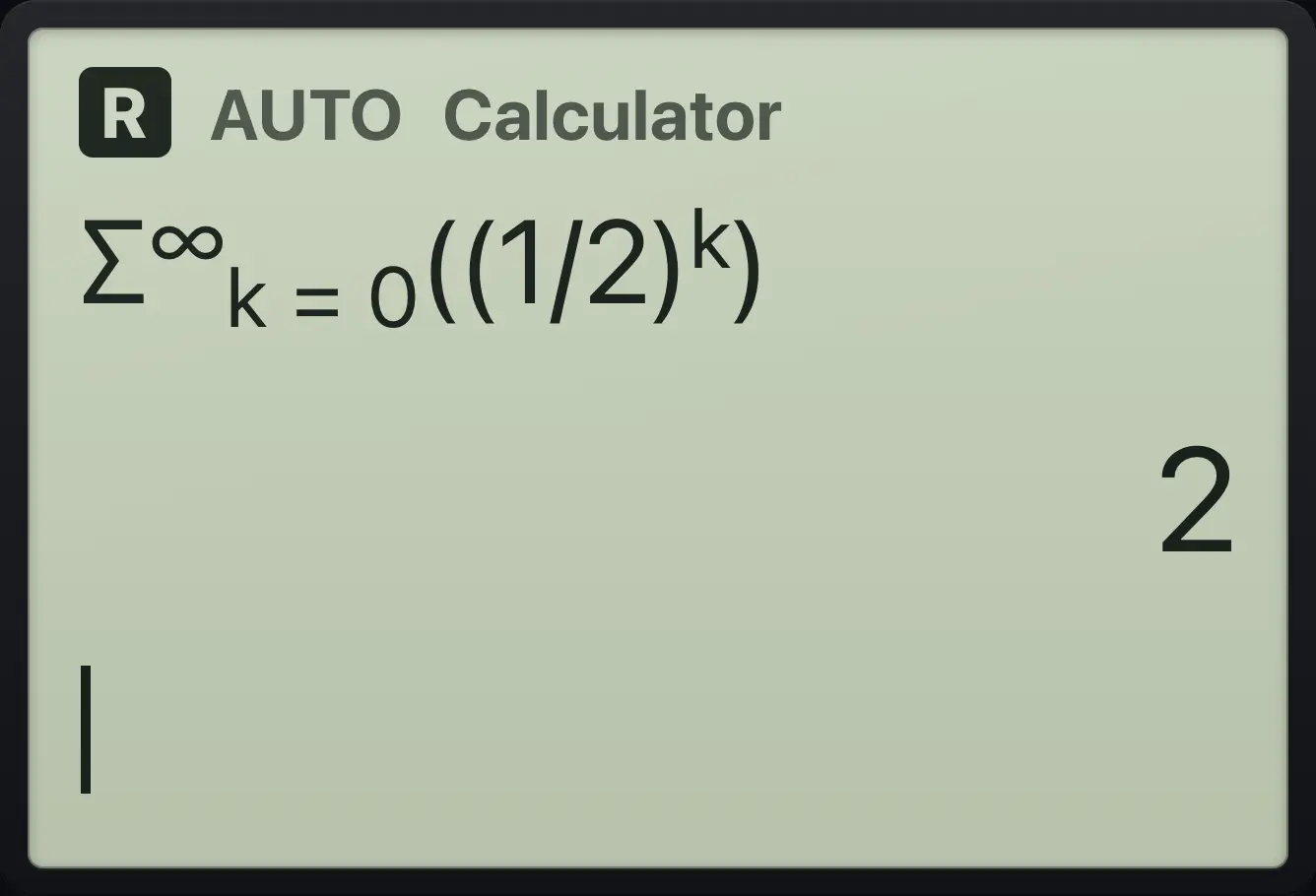
Result of the example "Infinite sum" The display shows: Σ((1/2)^k,k,0,∞) / 2.
You should see2

10.6Taylor series#

taylor(expression, variable, order) gives the polynomial about 0 up to the given order.

Example 10.27

Series of e to the x

ex≈1+x+x22+x36+x424e^{x}\approx 1+x+\frac{x^{2}}{2}+\frac{x^{3}}{6}+\frac{x^{4}}{24}
  1. Type taylor(e^x, x, 4).

    taylor(e^x▶,x,4)enter
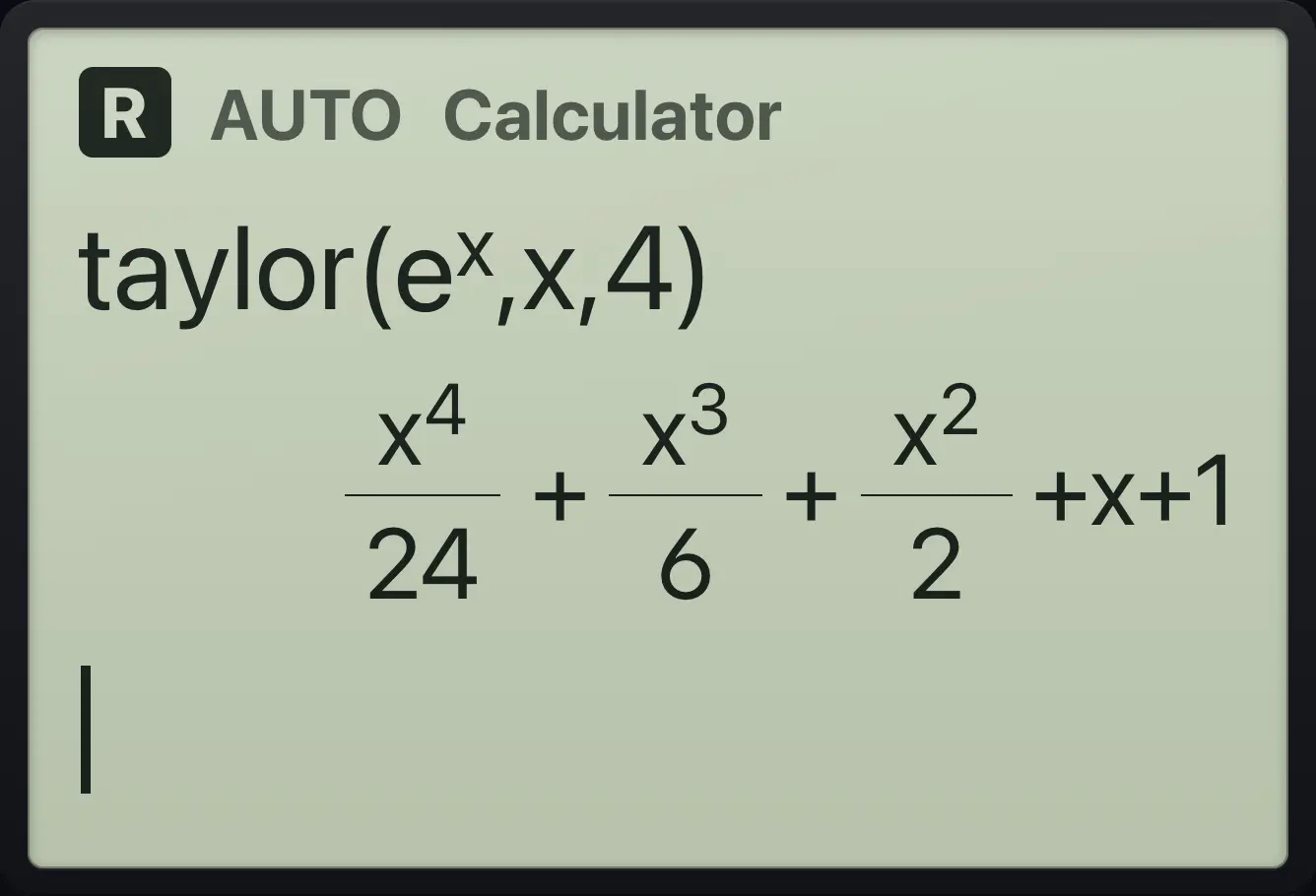
Result of the example "Series of e to the x" The display shows: taylor(e^x,x,4) / x^4/24+x^3/6+x^2/2+x+1.
You should seex^4/24+x^3/6+x^2/2+x+1
Example 10.28

Series of cosine

  1. Type taylor(cos(x), x, 4).

    taylor(cos(x),x,4)enter
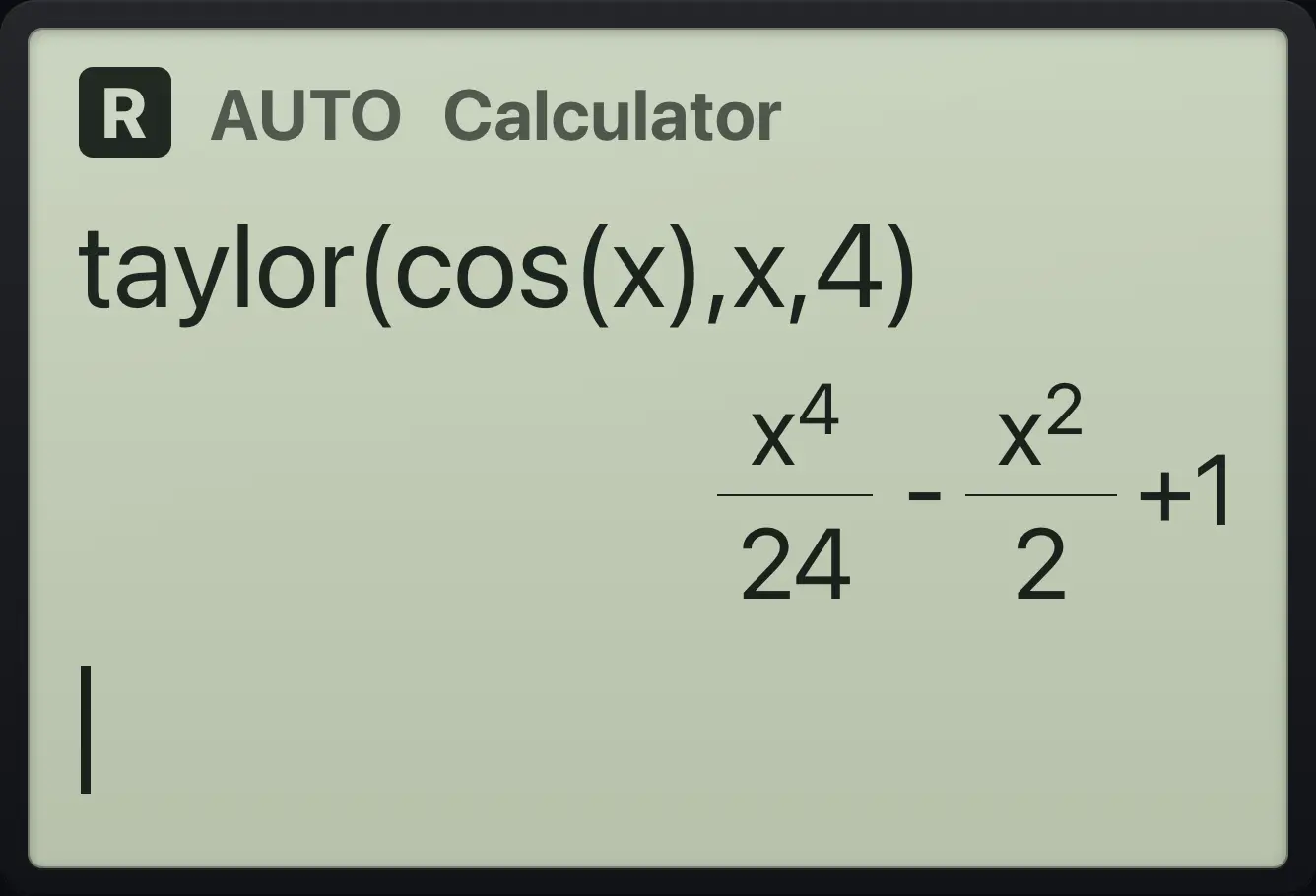
Result of the example "Series of cosine" The display shows: taylor(cos(x),x,4) / x^4/24-x^2/2+1.
You should seex^4/24-x^2/2+1

10.7Numeric derivative, integral, curve length#

nDeriv(f, x, point) gives a decimal derivative at a point. nInt(f, x, a, b) integrates numerically. arcLen(f, x, a, b) gives the length of the curve.

Example 10.29

Numeric derivative

  1. Type nDeriv(x³, x, 2).

    nderiv(x^3▶,x,2)enter
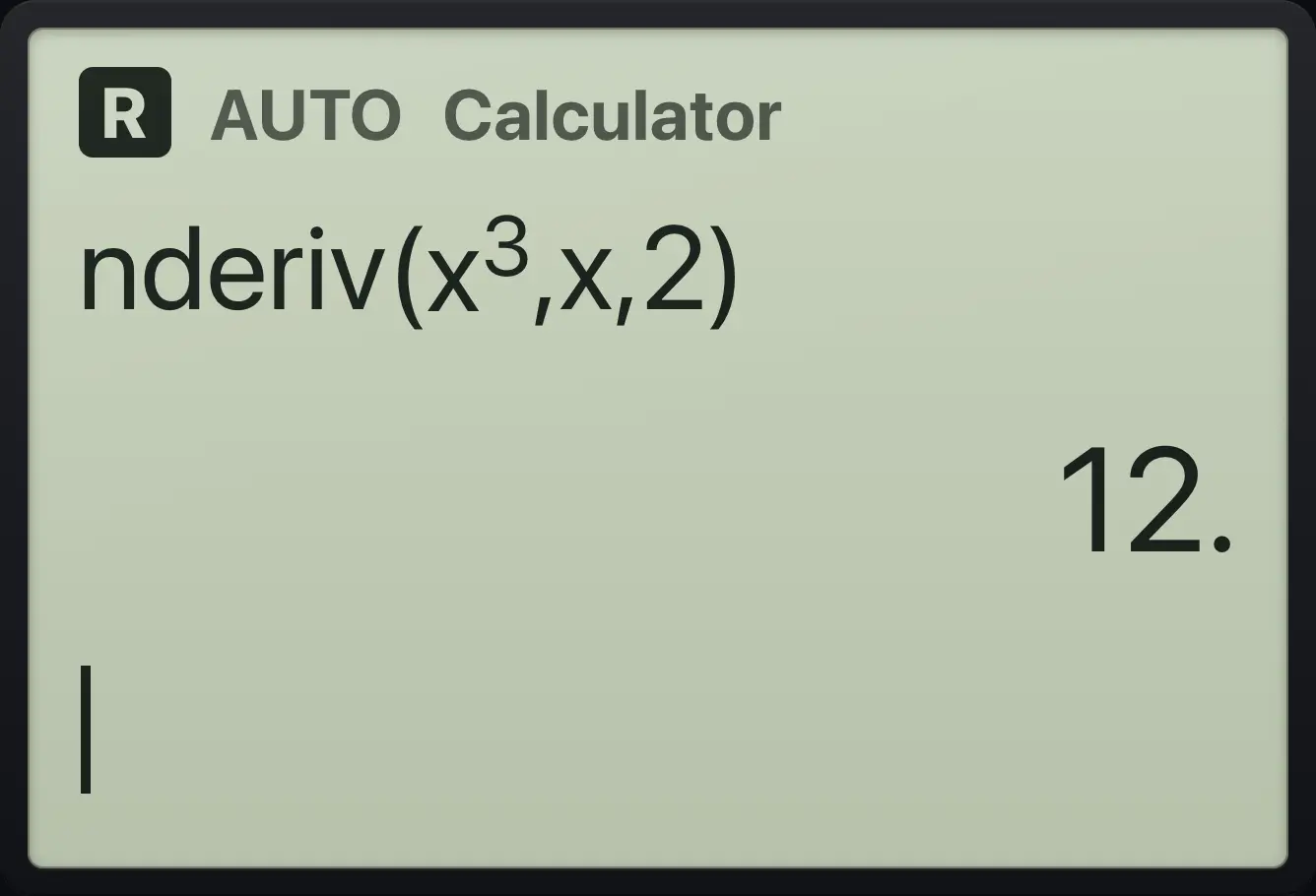
Result of the example "Numeric derivative" The display shows: nderiv(x^3,x,2) / 12..
You should see12.
Example 10.30

Numeric integral

  1. Type nInt(x², x, 0, 1).

    nint(x^2▶,x,0,1)enter
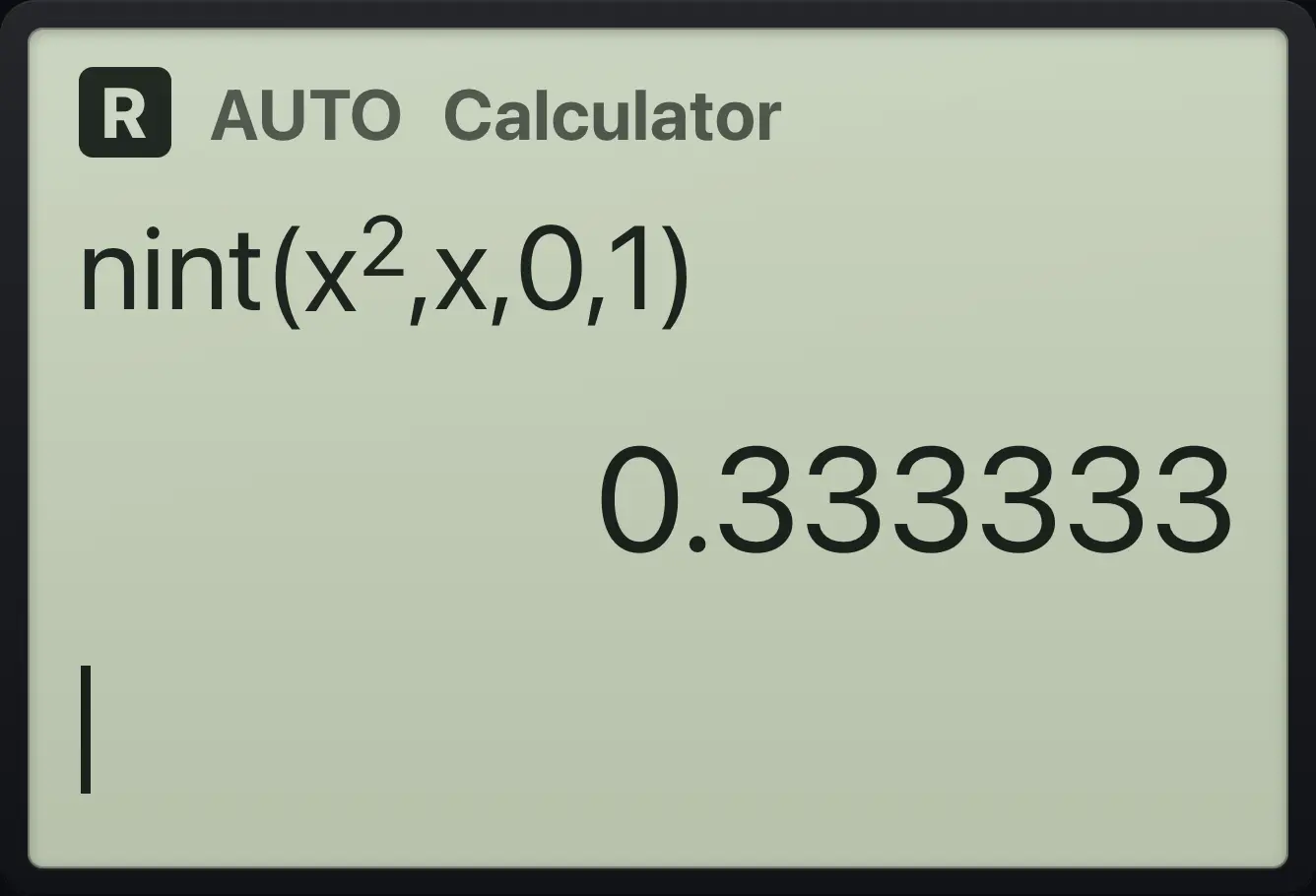
Result of the example "Numeric integral" The display shows: nint(x^2,x,0,1) / 0.333333.
You should see0.333333
Example 10.31

Arc length

L=∫ab1+f′(x)2 dxL=\int_{a}^{b}\sqrt{1+f^{\prime}(x)^{2}}\,dx
  1. Type arcLen(x², x, 0, 1).

    arclen(x^2▶,x,0,1)enter
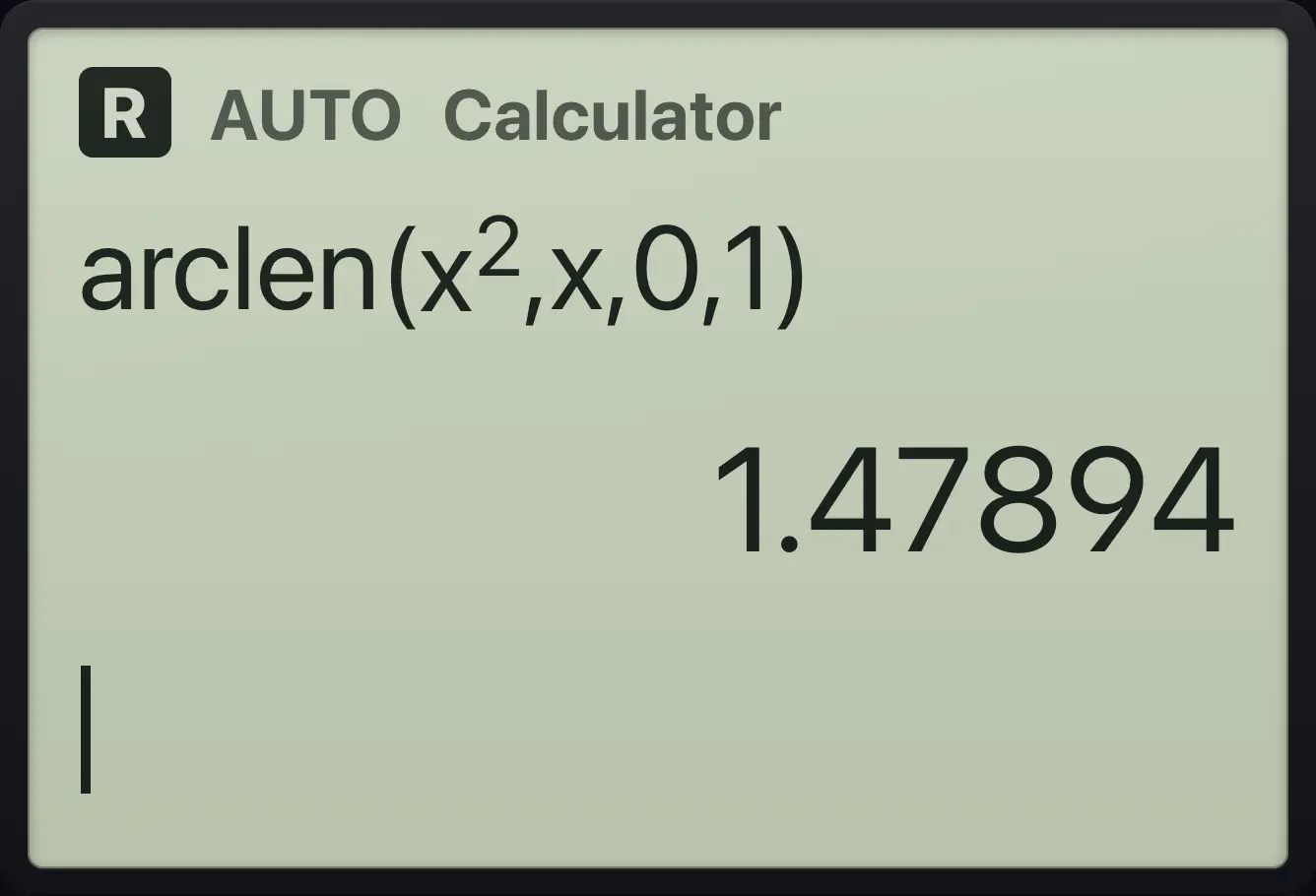
Result of the example "Arc length" The display shows: arclen(x^2,x,0,1) / 1.47894.
You should see1.47894

10.8Tangent lines and extreme values#

Example 10.32

Tangent line

y=f(3)+f′(3)(x−3)=6x−9y=f(3)+f^{\prime}(3)(x-3)=6x-9
  1. Type tangentLine(x², x, 3).

    tangentline(x^2▶,x,3)enter
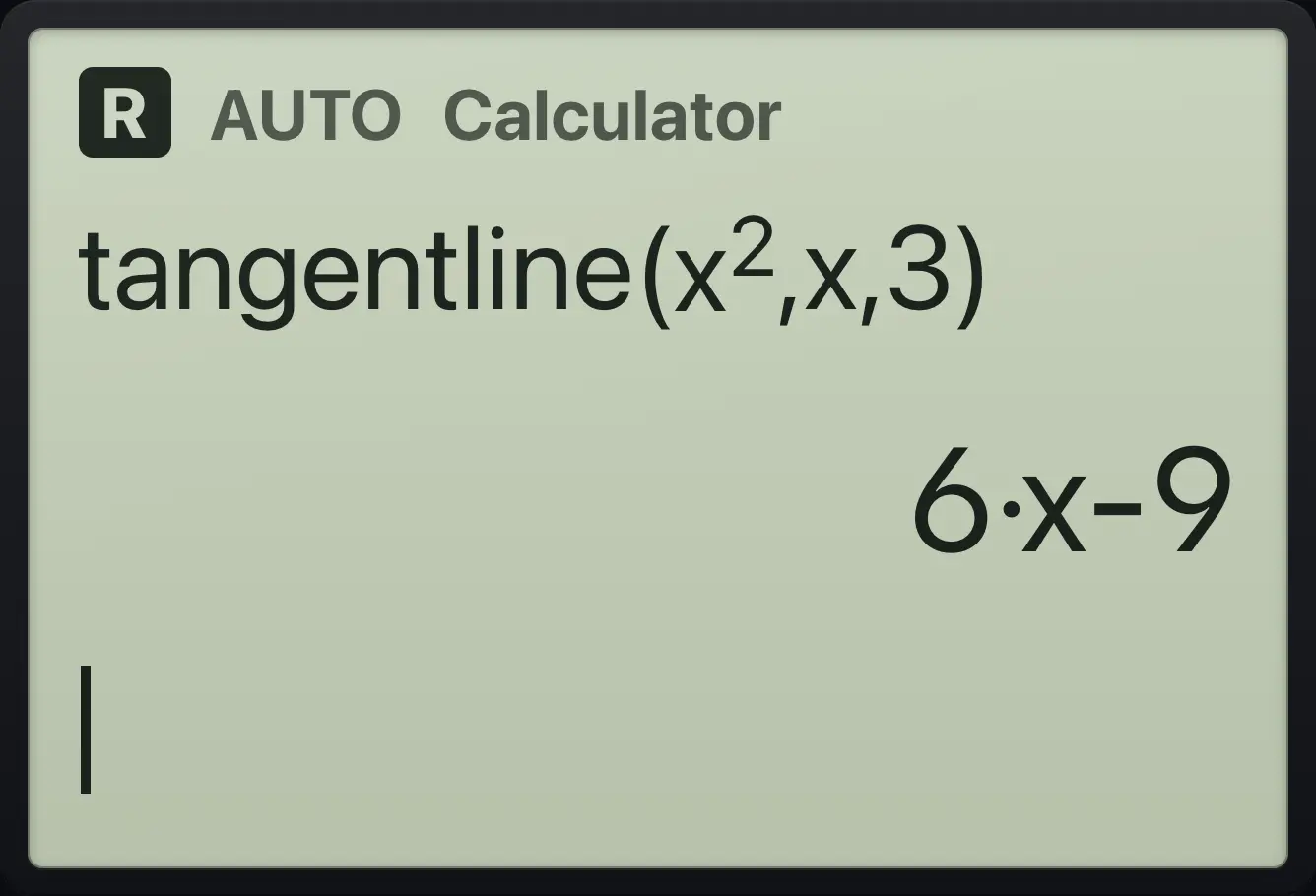
Result of the example "Tangent line" The display shows: tangentline(x^2,x,3) / 6·x-9.
You should see6·x-9
Example 10.33

Normal line

  1. Type normalLine(x², x, 3).

    normalline(x^2▶,x,3)enter
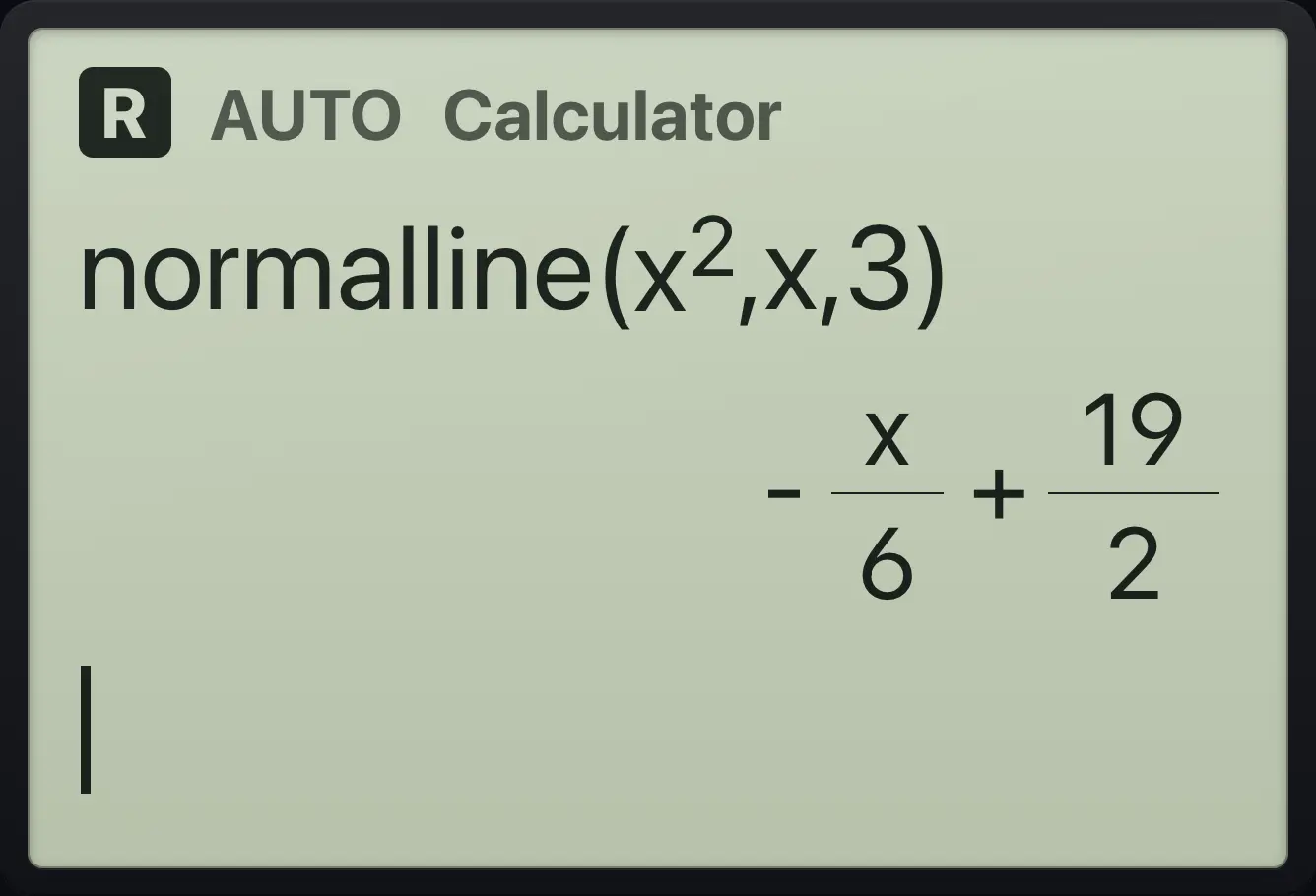
Result of the example "Normal line" The display shows: normalline(x^2,x,3) / -x/6+19/2.
You should see-x/6+19/2
Example 10.34

Minimum

  1. Type fMin(x²−2x, x).

    fmin(x^2▶−2x,x)enter
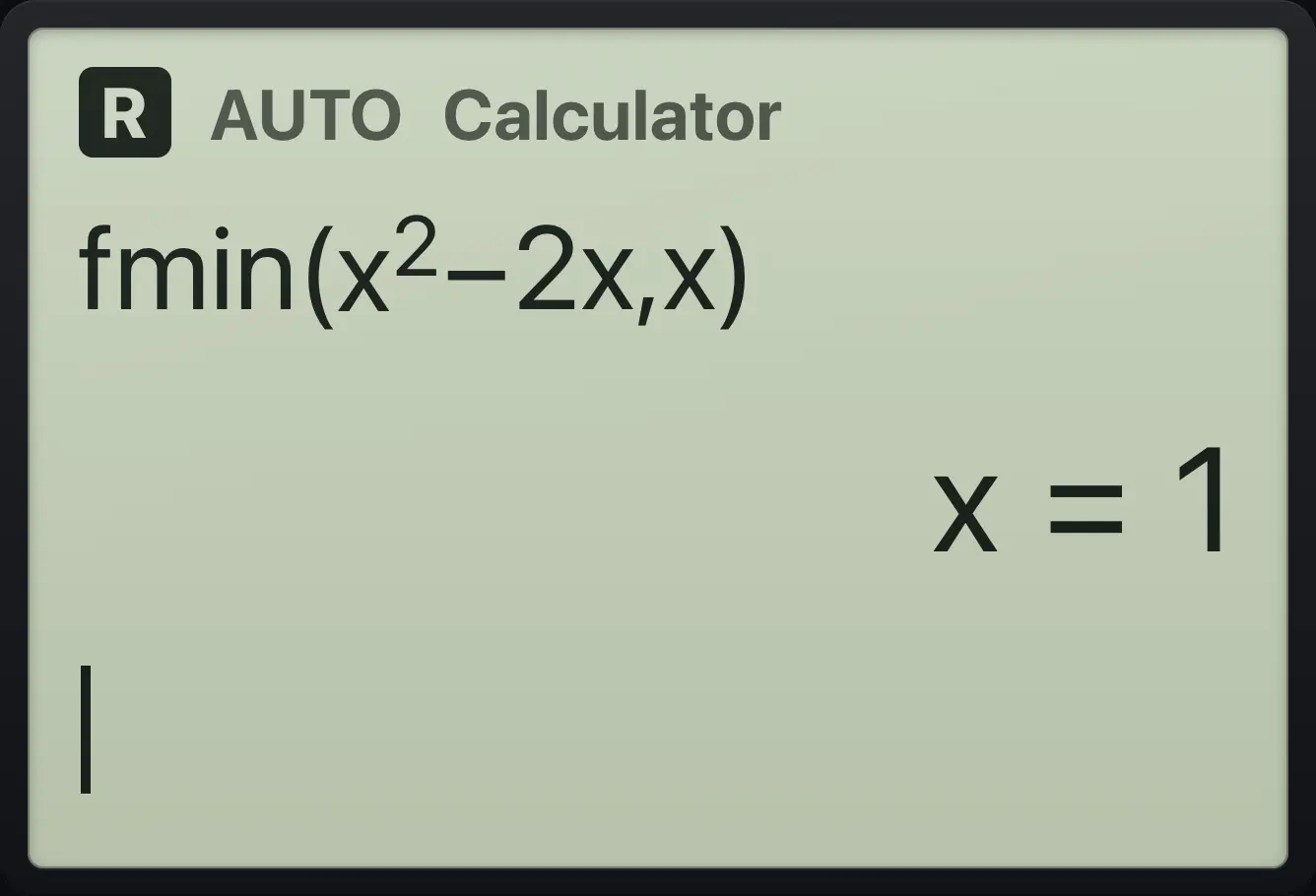
Result of the example "Minimum" The display shows: fmin(x^2−2x,x) / x=1.
You should seex=1
Example 10.35

Maximum

  1. Type fMax(4−x², x).

    fmax(4−x^2▶,x)enter
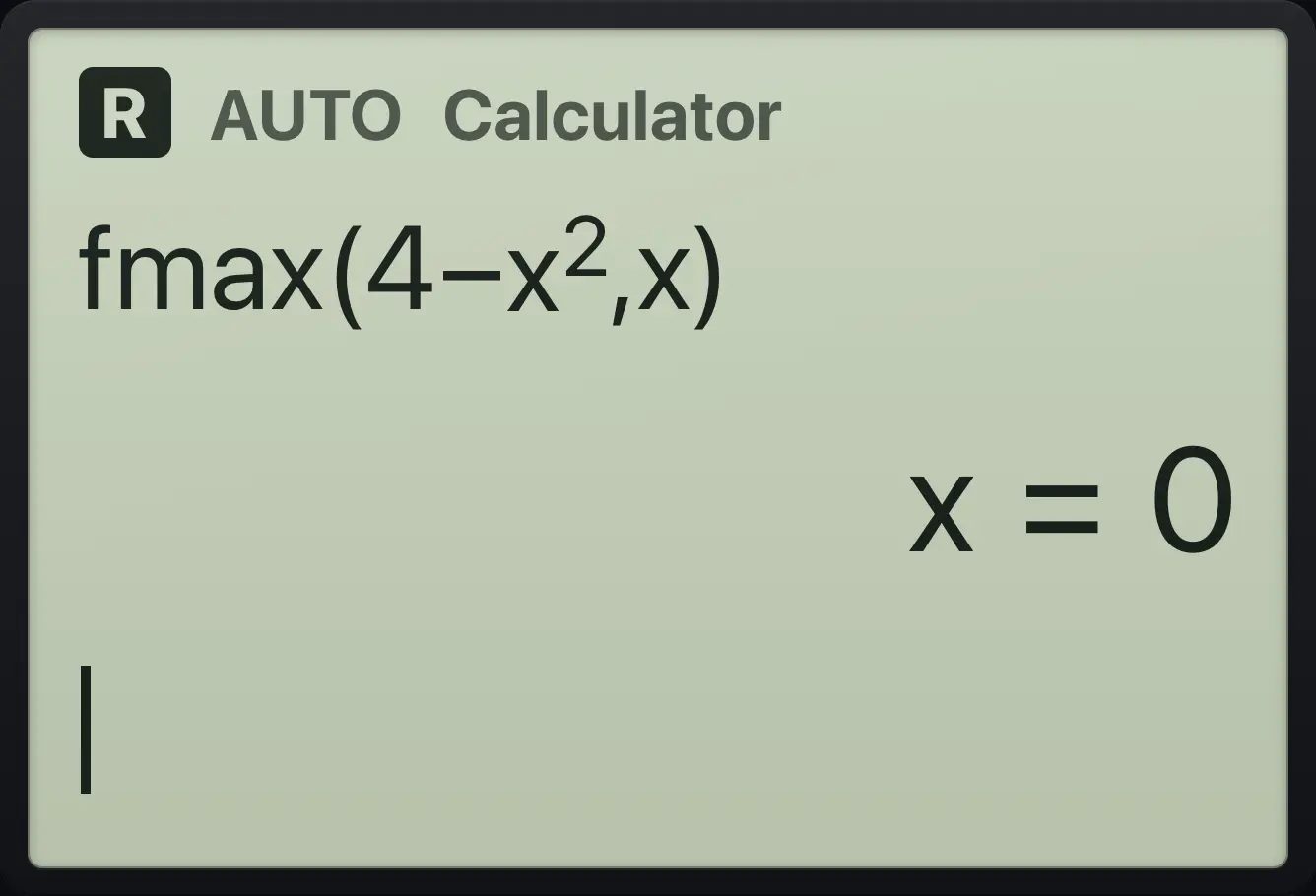
Result of the example "Maximum" The display shows: fmax(4−x^2,x) / x=0.
You should seex=0

TI-Nspire CX CAS is a trademark of Texas Instruments Incorporated. Trident Calculator is an independent product by South View Studios and is not affiliated with, sponsored by or endorsed by Texas Instruments. The name is used only to describe the kind of calculator this model resembles; Trident's names, keys, display, fonts and software are its own clean-room design.