
Trident Help

Classic CAS manual · Chapter 12 of 16

Lists, statistics and probability

Lists in curly braces, list arithmetic, summary statistics and probability distributions.

12.1Type and use a list#

A list is a set of values in curly braces. Open it with shift{( and close with shift}), with commas between the items. Math on a list applies to every item.

Example 12.1

Multiply a list

  1. Type {1,2,3} × 2.

    shift{(1,2,3shift})×2enter
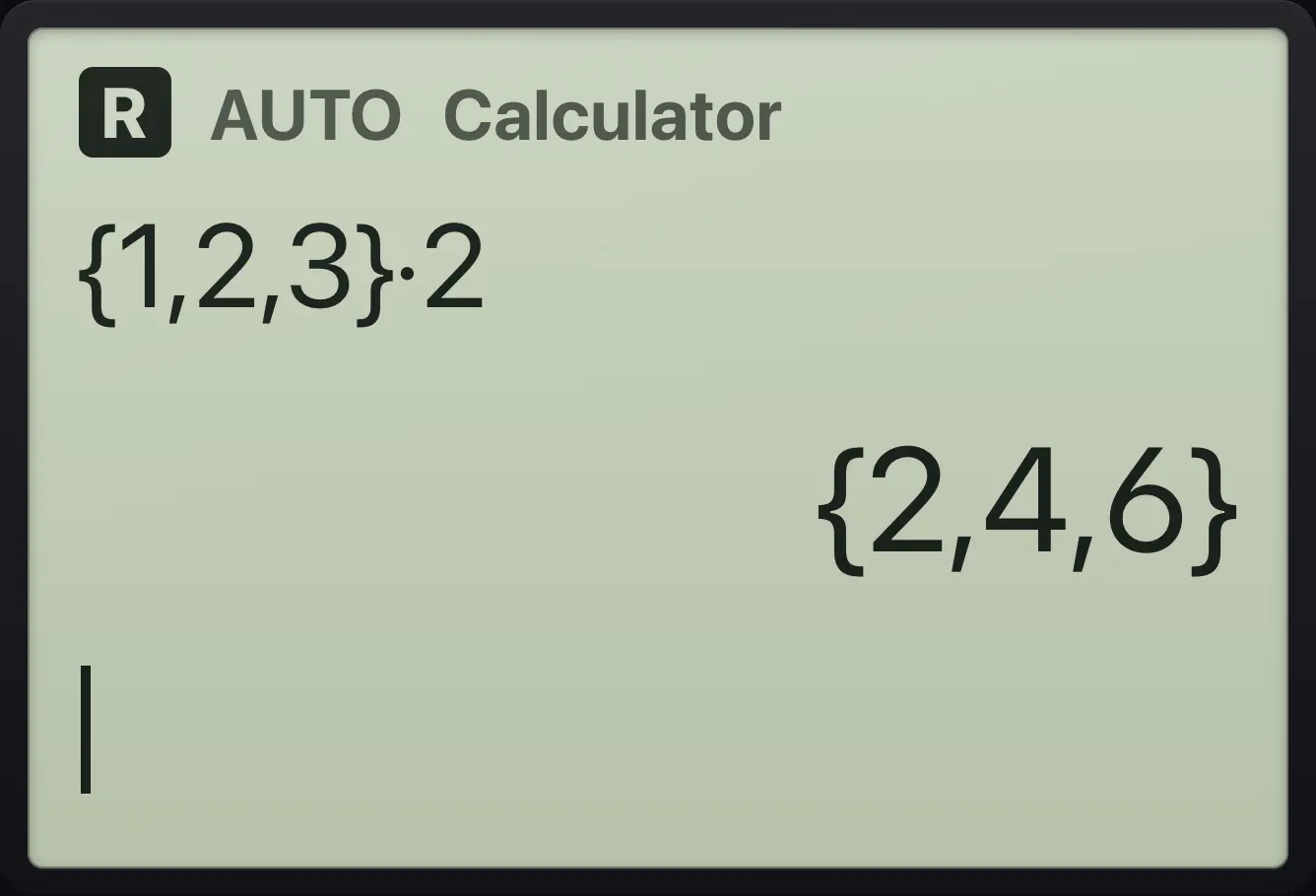
Result of the example "Multiply a list" The display shows: {1,2,3}·2 / {2,4,6}.
You should see{2,4,6}
Example 12.2

Add two lists

  1. Type {1,2,3} + {4,5,6}.

    shift{(1,2,3shift})+shift{(4,5,6shift})enter
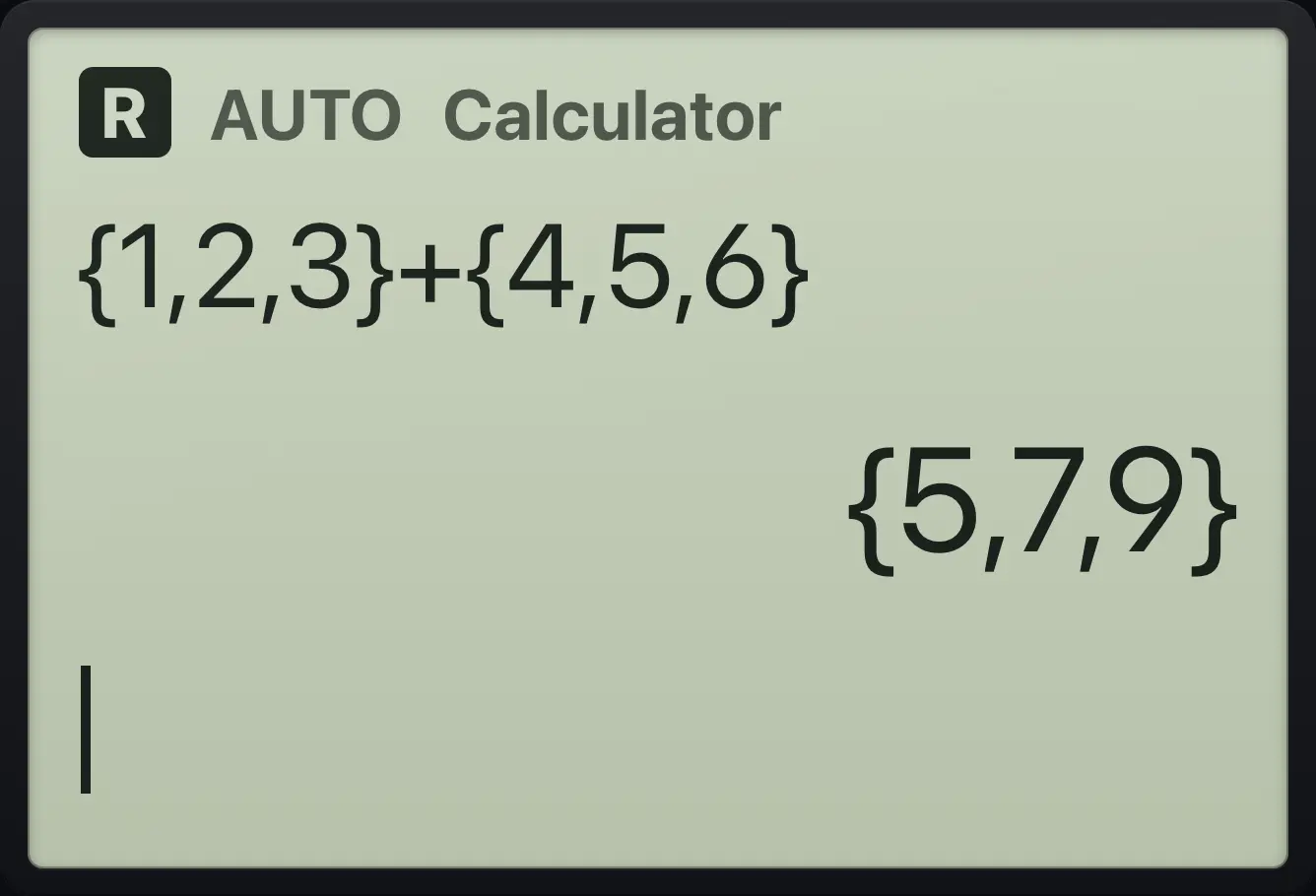
Result of the example "Add two lists" The display shows: {1,2,3}+{4,5,6} / {5,7,9}.
You should see{5,7,9}
Example 12.3

Square roots of a list

  1. Type sqrt({4,9}).

    sqrt(shift{(4,9shift}))enter
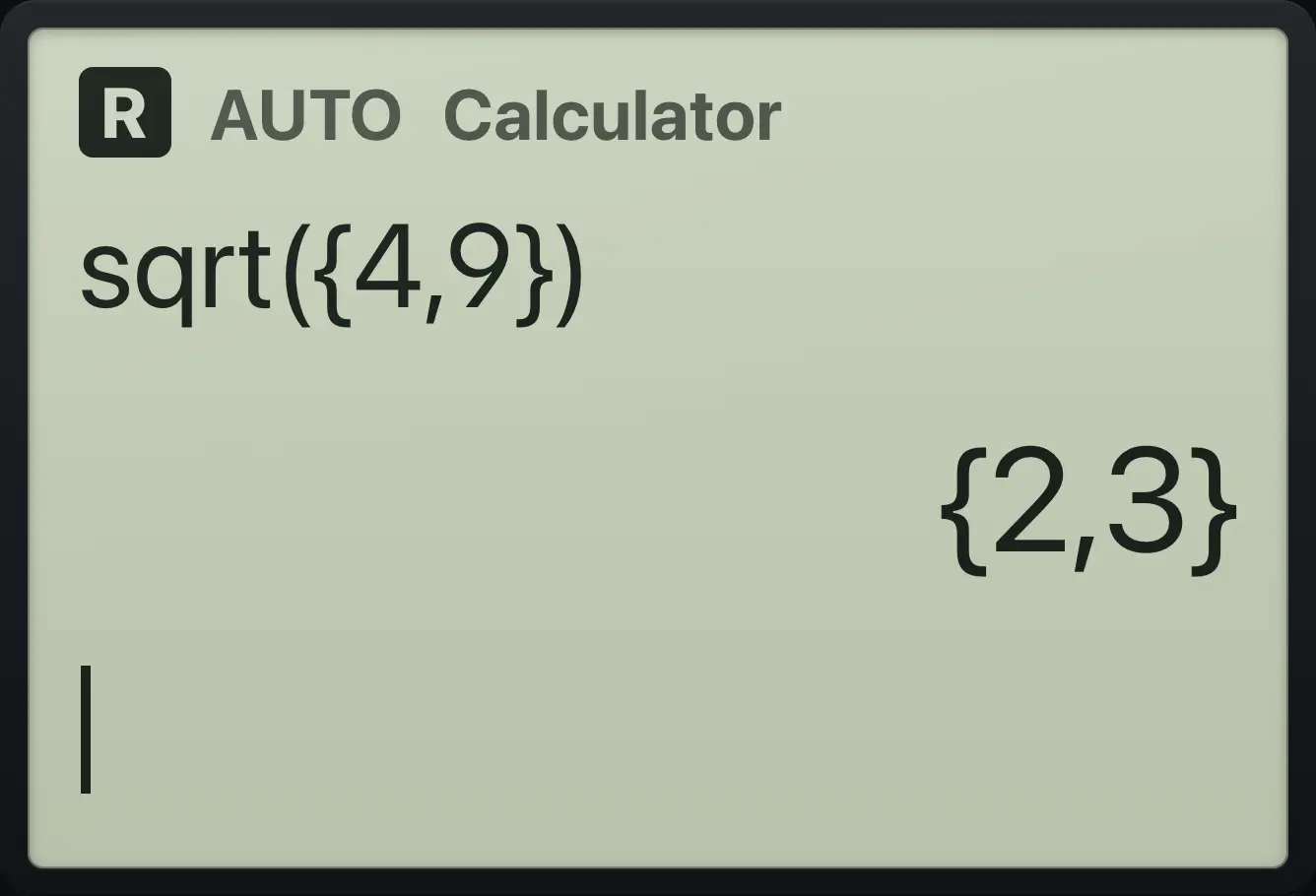
Result of the example "Square roots of a list" The display shows: sqrt({4,9}) / {2,3}.
You should see{2,3}
Example 12.4

Store a list

  1. Store l := {1,2,3}, then take mean(l).

    l:=shift{(1,2,3shift})entermean(l)enter
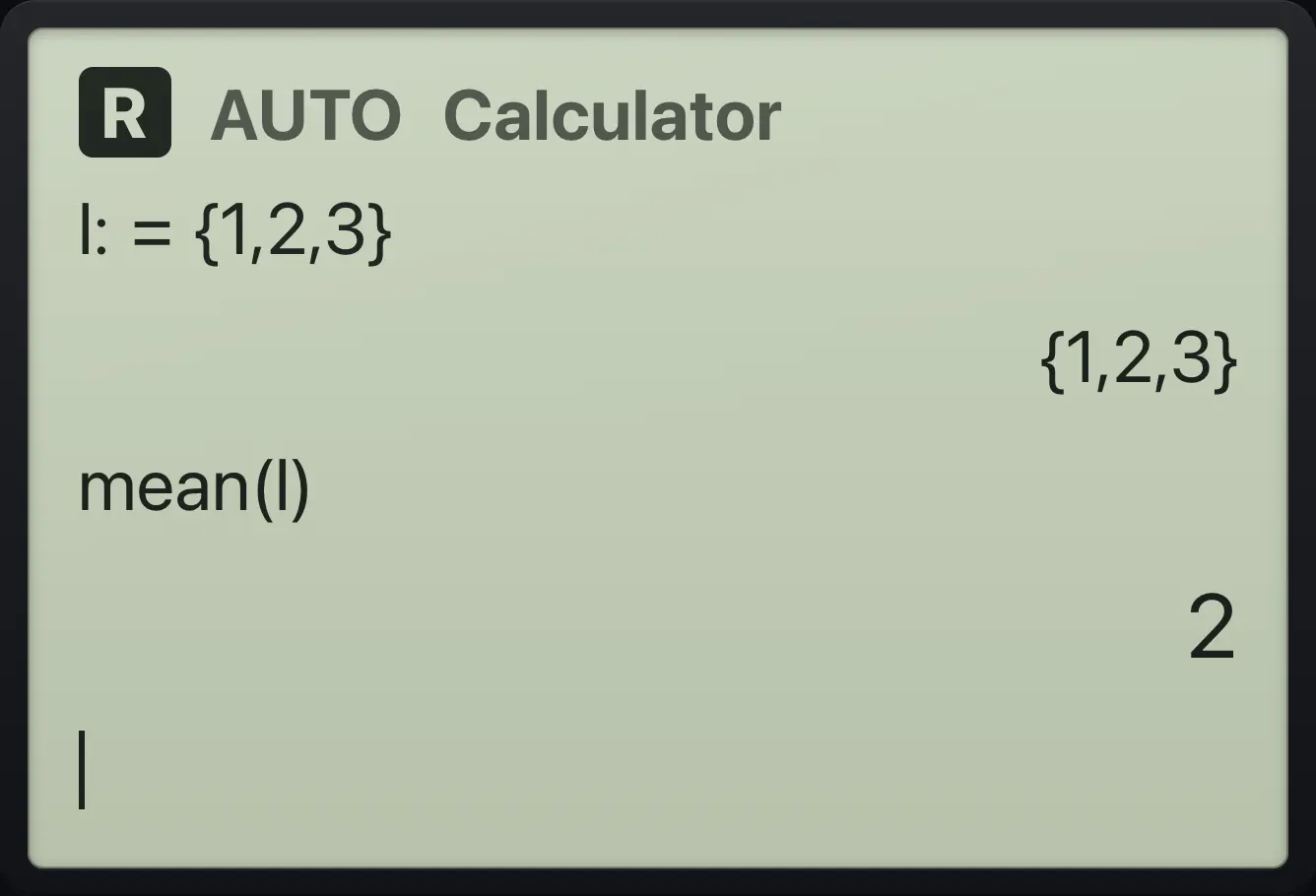
Result of the example "Store a list" The display shows: l:={1,2,3} / {1,2,3} / mean(l) / 2.
You should seel:={1,2,3} 2
Example 12.5

Make a list with seq

  1. Type seq(n², n, 1, 5).

    seq(n^2▶,n,1,5)enter
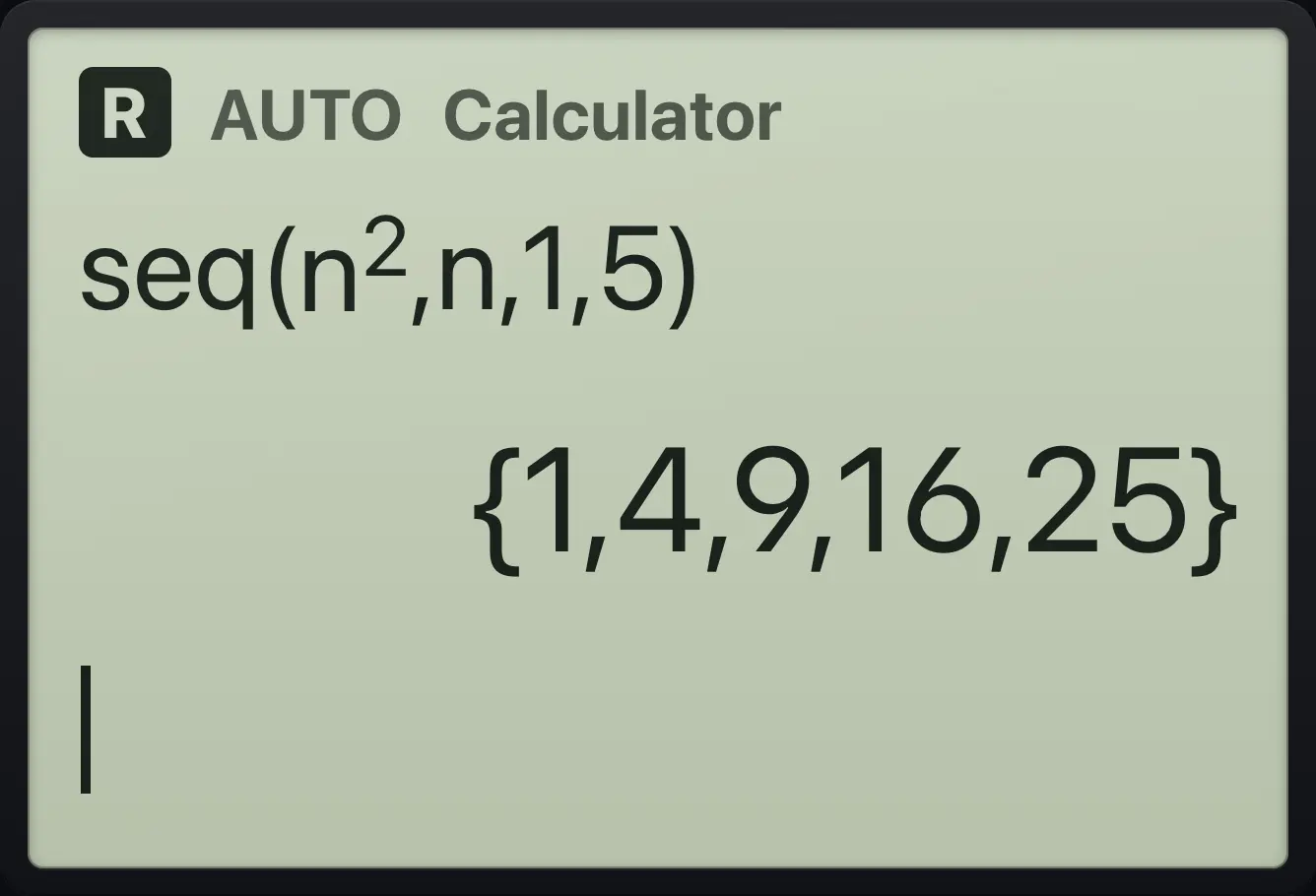
Result of the example "Make a list with seq" The display shows: seq(n^2,n,1,5) / {1,4,9,16,25}.
You should see{1,4,9,16,25}
Example 12.6

Running totals

  1. Type cumulativeSum({1,2,3}).

    cumulativesum(shift{(1,2,3shift}))enter
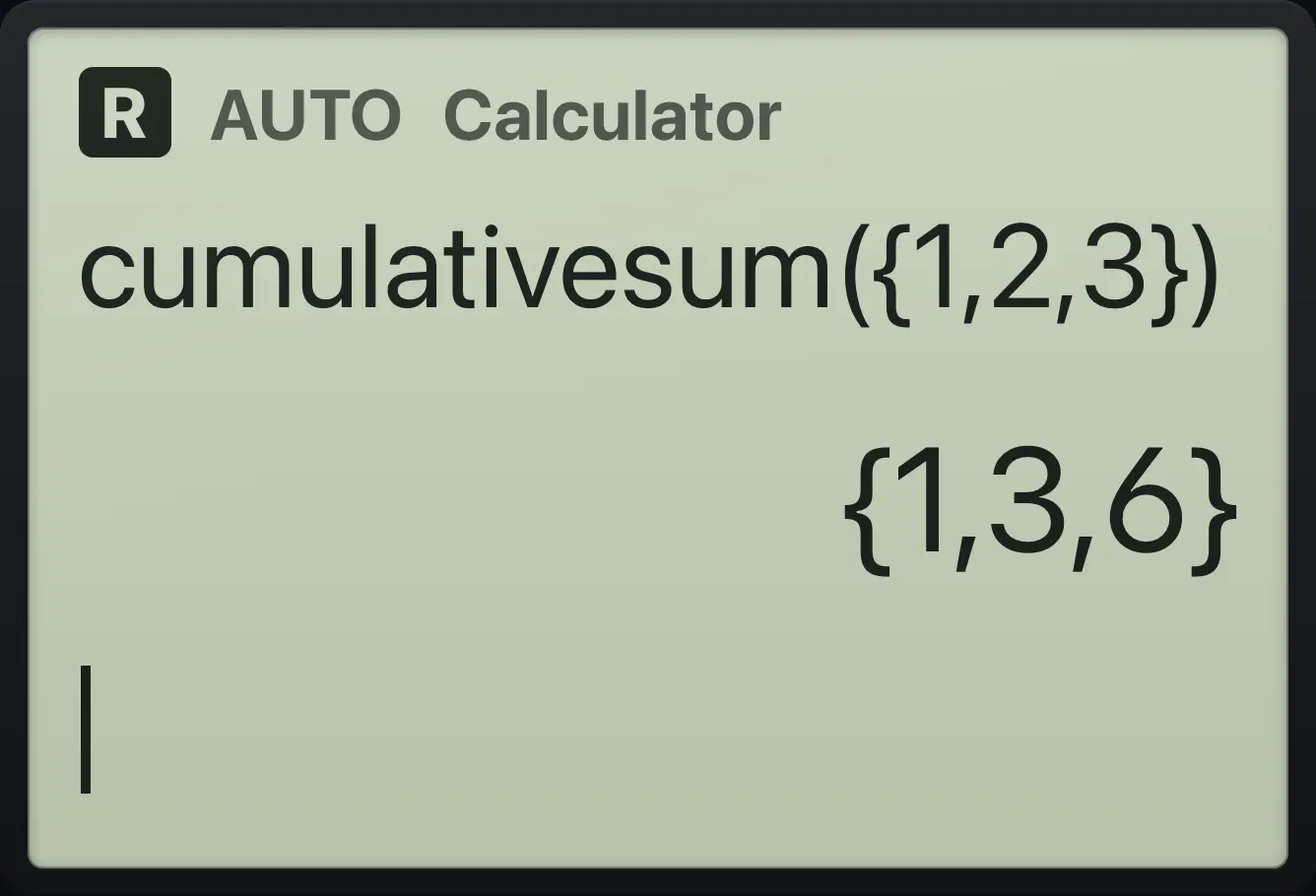
Result of the example "Running totals" The display shows: cumulativesum({1,2,3}) / {1,3,6}.
You should see{1,3,6}
Example 12.7

Size of a list

  1. Type dim({1,2,3}).

    dim(shift{(1,2,3shift}))enter
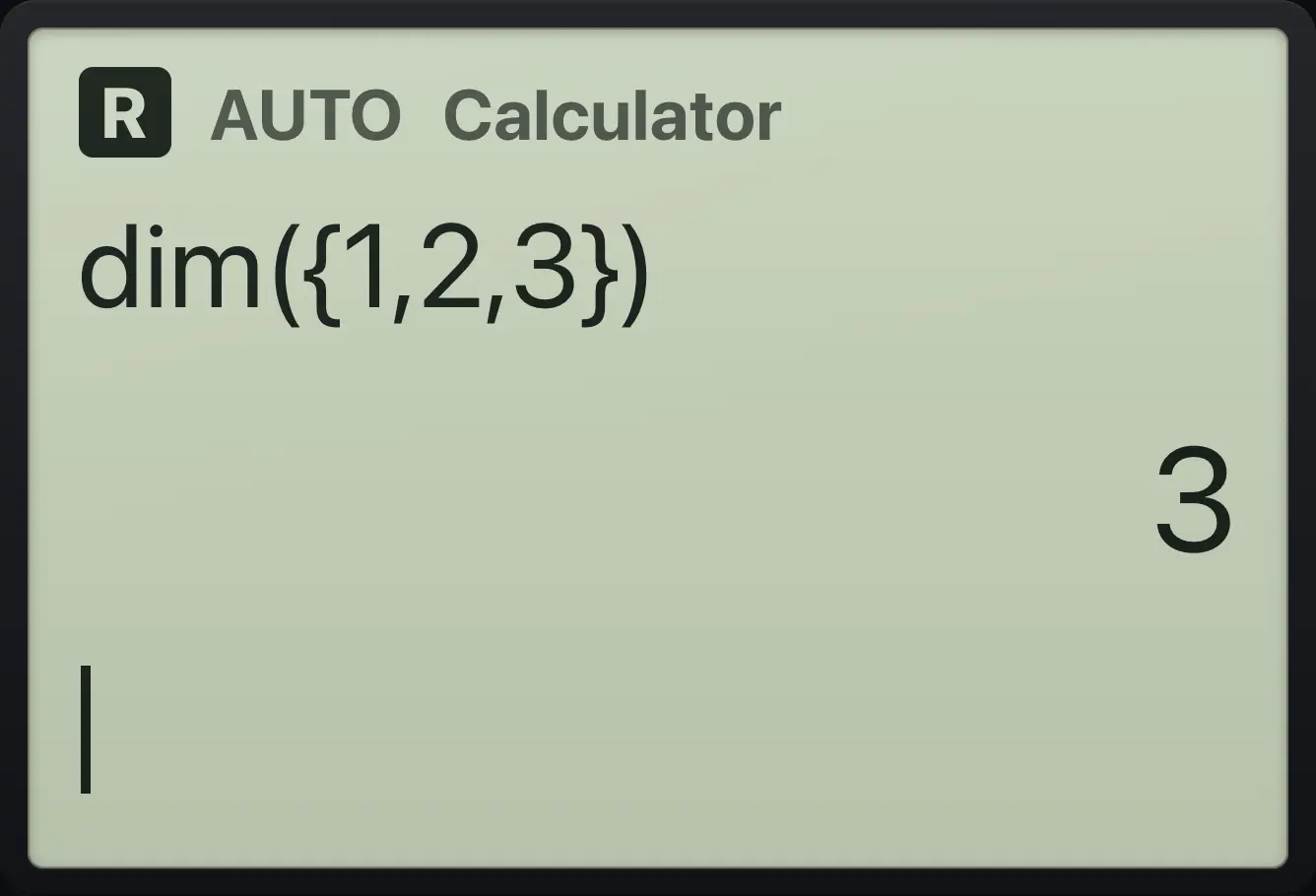
Result of the example "Size of a list" The display shows: dim({1,2,3}) / 3.
You should see3

12.2Mean, median and spread#

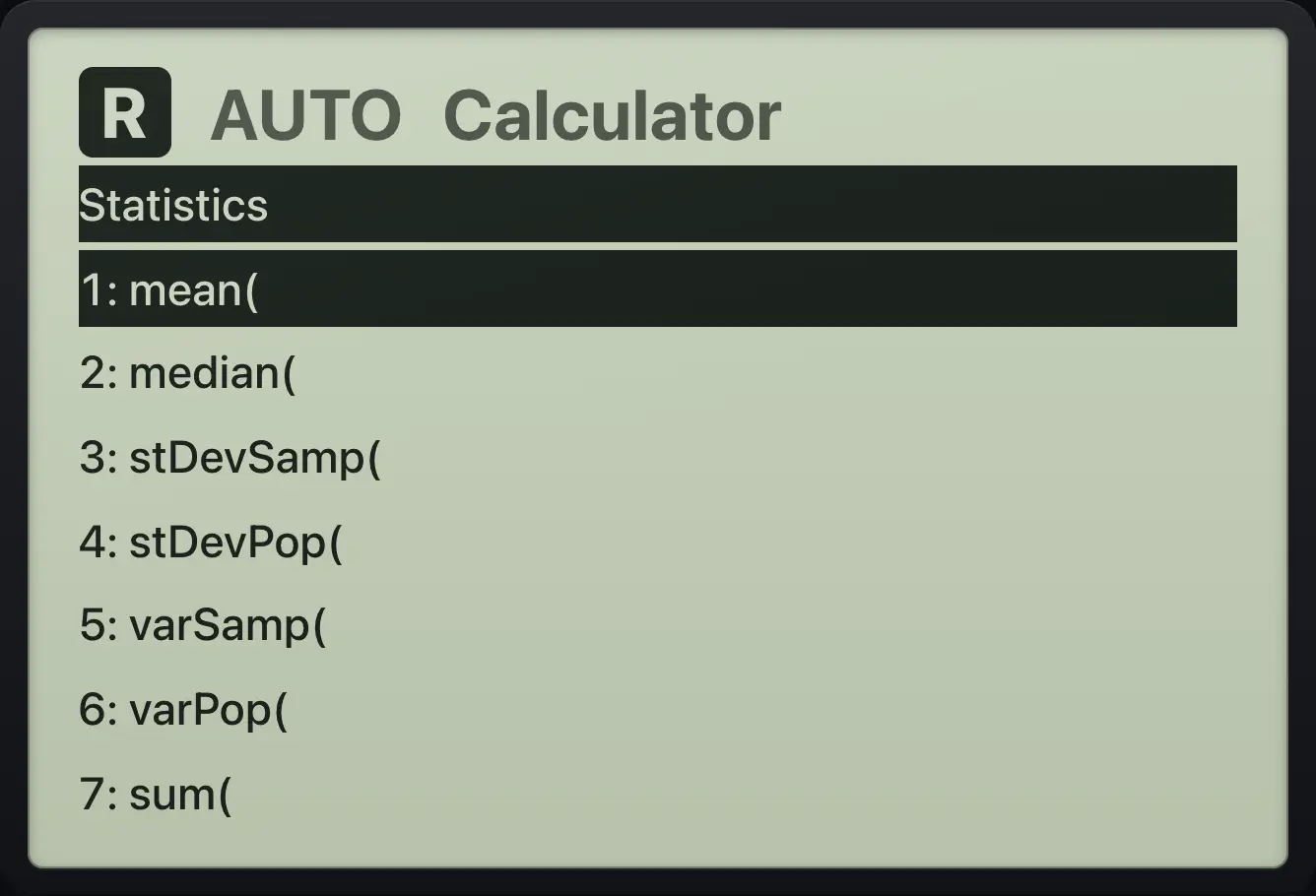
The Statistics menu (menu, 6) holds mean, median, stDevSamp, stDevPop, varSamp, varPop, sum, product, cumulativeSum, seq, max and min. Answers stay exact.
s=∑(xi−xˉ)2n−1,σ=∑(xi−xˉ)2ns=\sqrt{\frac{\sum (x_i-\bar x)^2}{n-1}},\qquad \sigma=\sqrt{\frac{\sum (x_i-\bar x)^2}{n}}
Sample and population standard deviation.
The Statistics menu. The display shows: Statistics / 1: mean( / 2: median( / 3: stDevSamp( / 4: stDevPop( / 5: varSamp( / 6: varPop( / 7: sum(.
The Statistics menu.
Example 12.8

Mean

  1. Type mean({1,2,3,4}).

    mean(shift{(1,2,3,4shift}))enter
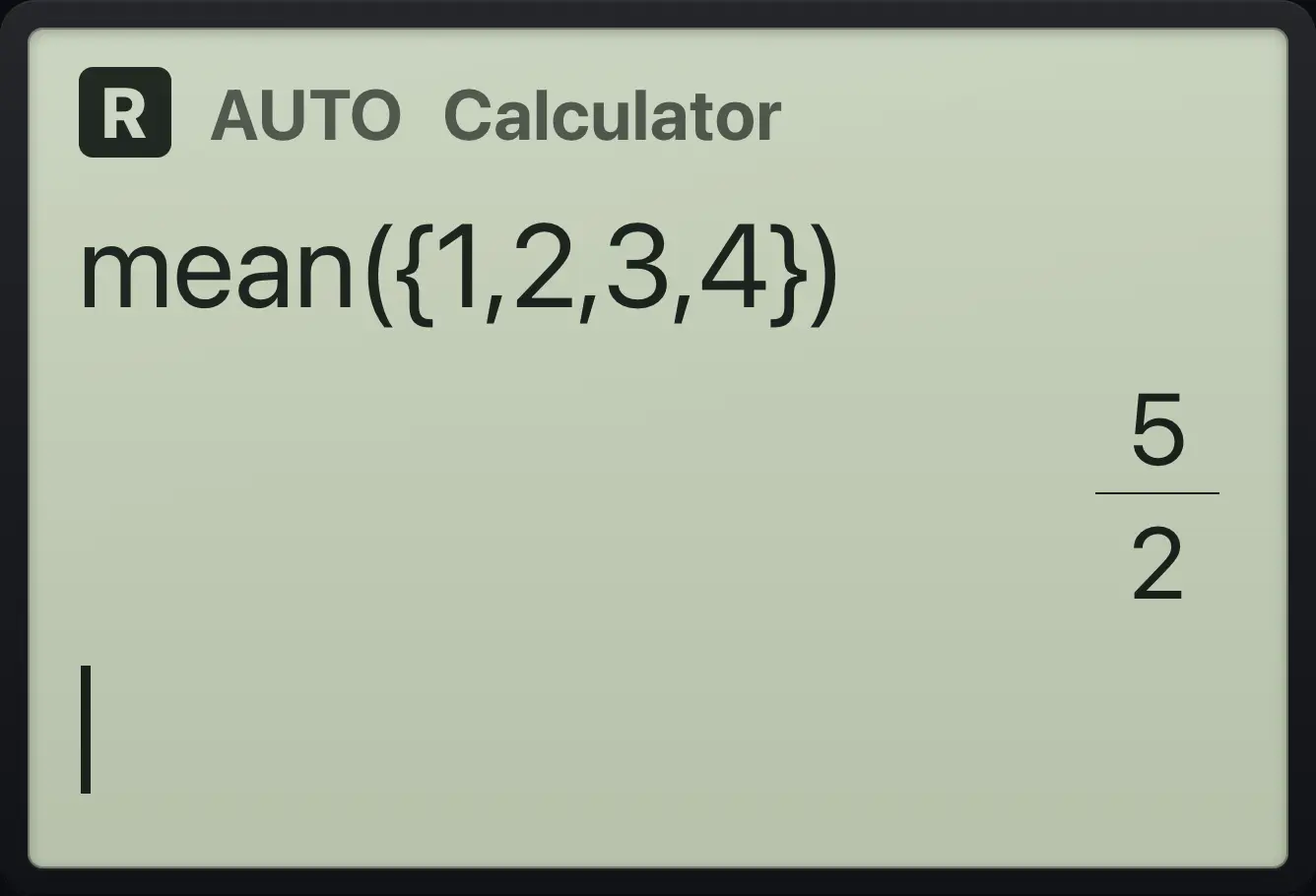
Result of the example "Mean" The display shows: mean({1,2,3,4}) / 5/2.
You should see5/2
Example 12.9

Median

  1. Type median({1,3,2,4}).

    median(shift{(1,3,2,4shift}))enter
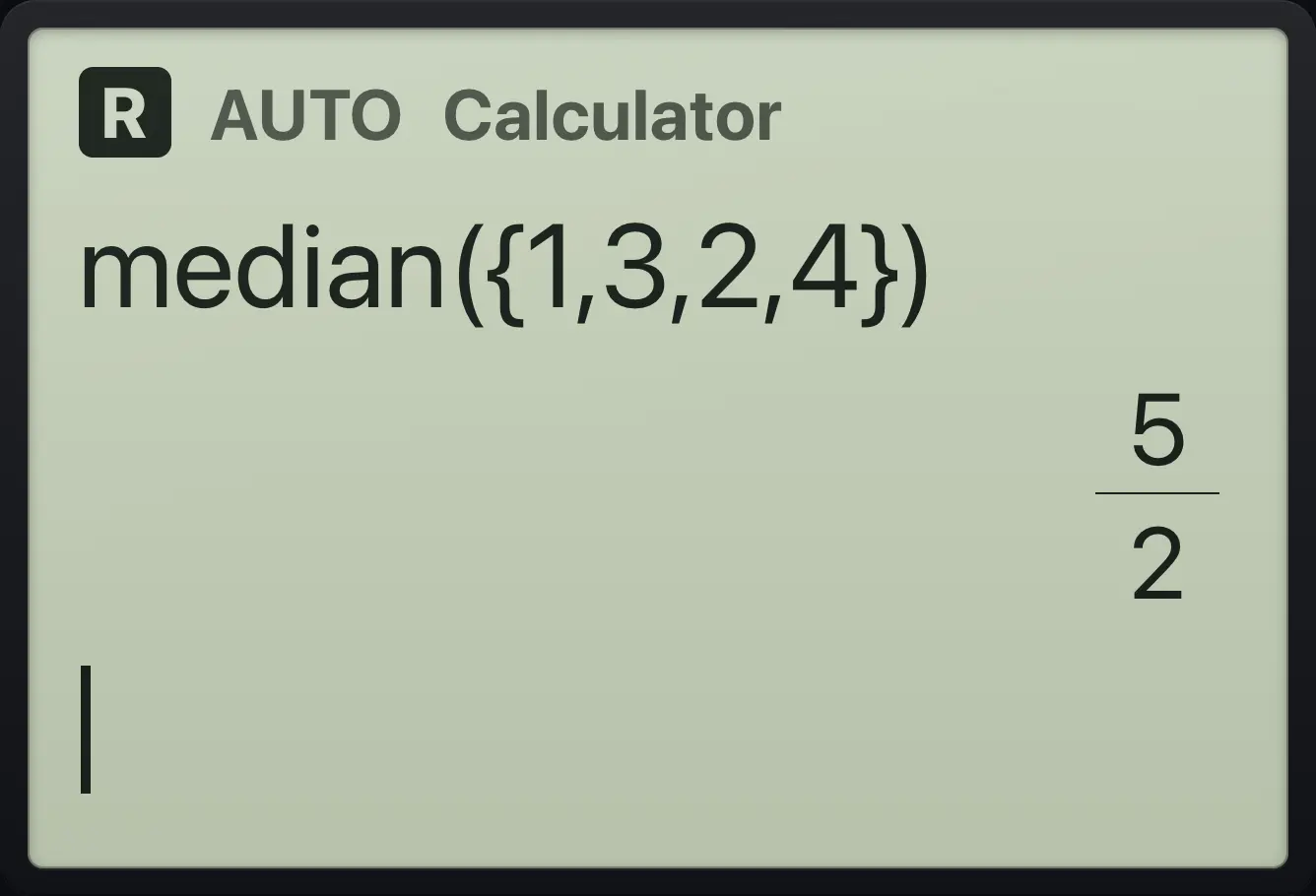
Result of the example "Median" The display shows: median({1,3,2,4}) / 5/2.
You should see5/2
Example 12.10

Sample standard deviation

  1. Type stDevSamp({1,2,3,4}).

    stdevsamp(shift{(1,2,3,4shift}))enter
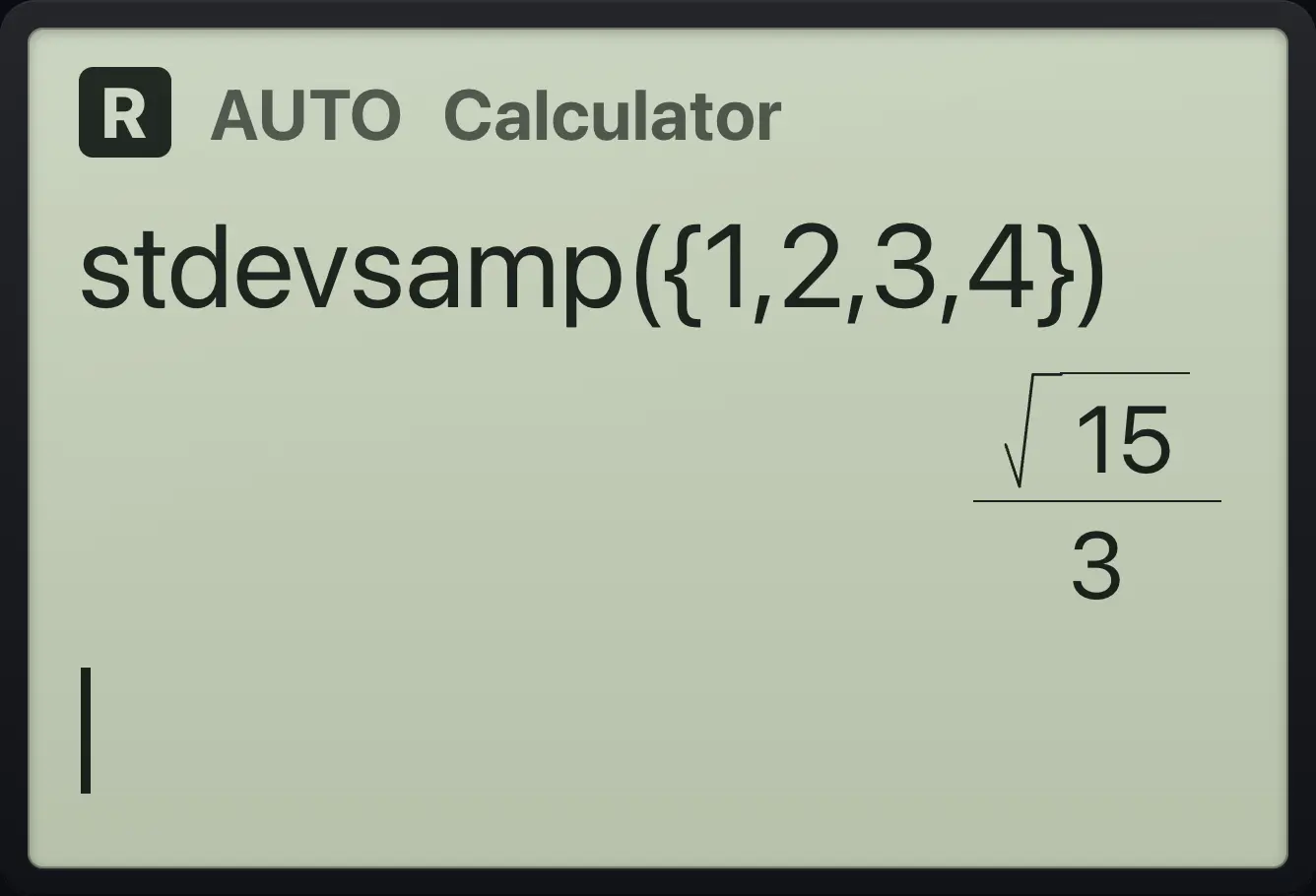
Result of the example "Sample standard deviation" The display shows: stdevsamp({1,2,3,4}) / √15/3.
You should see√15/3
Example 12.11

Population standard deviation

  1. Type stDevPop({1,2,3,4}).

    stdevpop(shift{(1,2,3,4shift}))enter
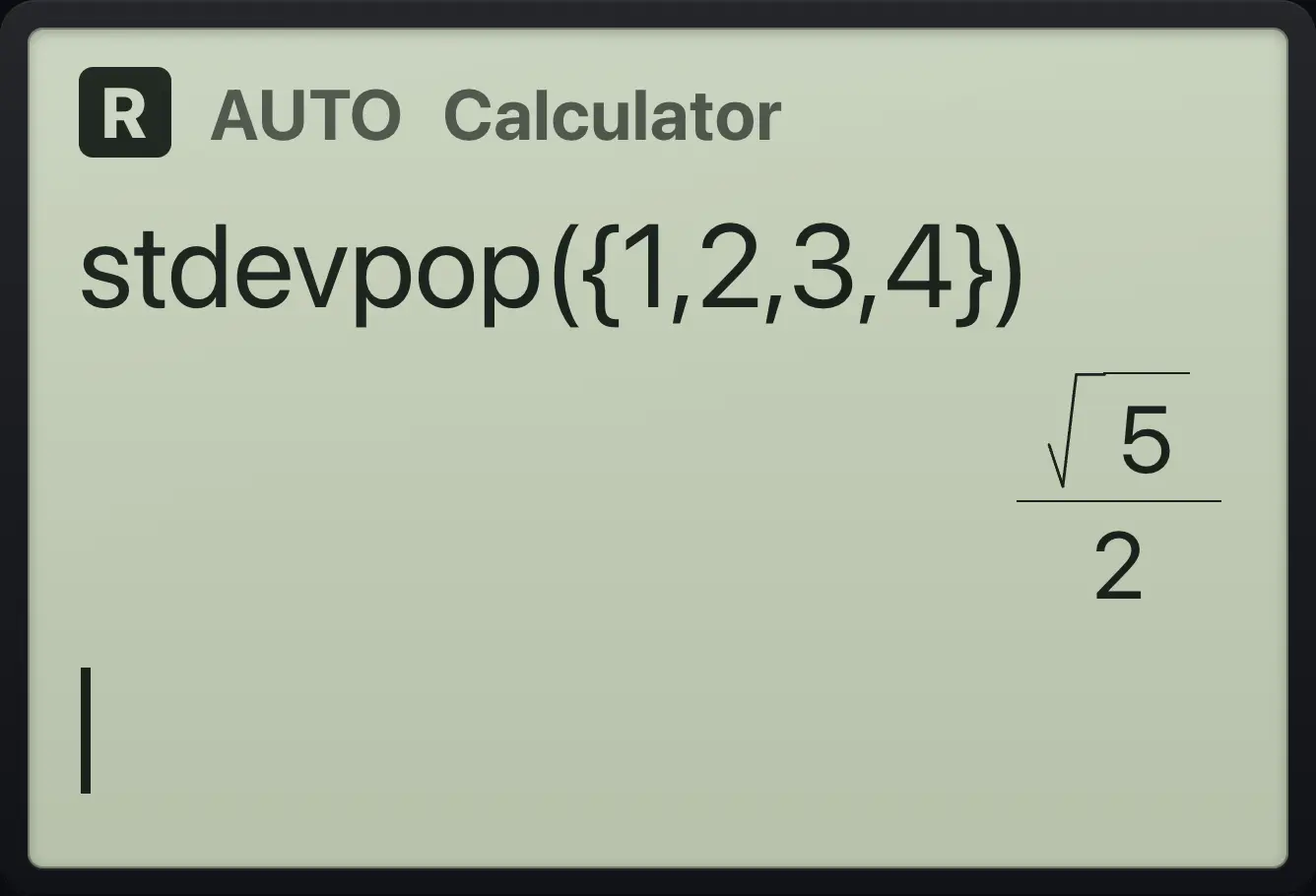
Result of the example "Population standard deviation" The display shows: stdevpop({1,2,3,4}) / √5/2.
You should see√5/2
Example 12.12

Sample variance

  1. Type varSamp({1,2,3,4}).

    varsamp(shift{(1,2,3,4shift}))enter
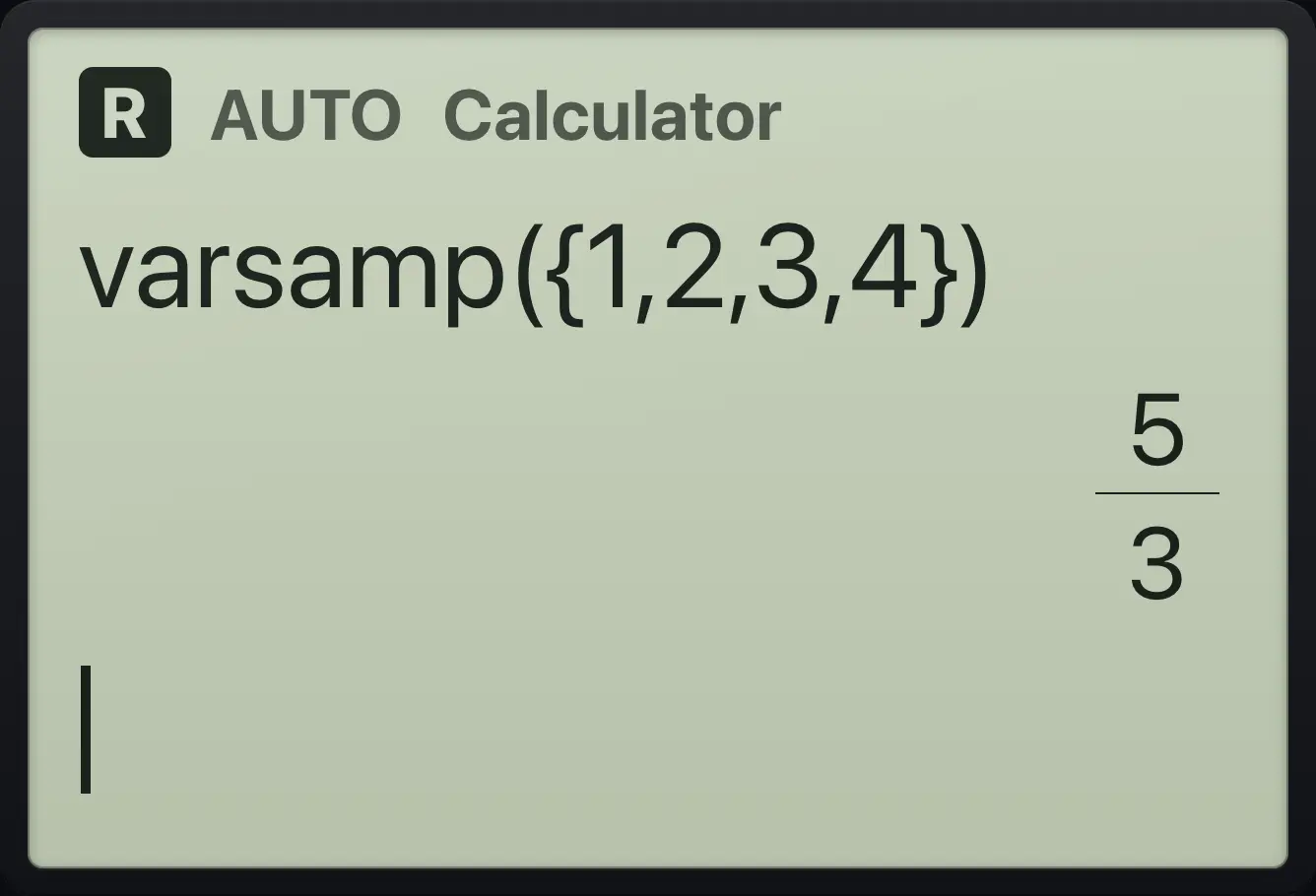
Result of the example "Sample variance" The display shows: varsamp({1,2,3,4}) / 5/3.
You should see5/3
Example 12.13

Population variance

  1. Type varPop({1,2,3,4}).

    varpop(shift{(1,2,3,4shift}))enter
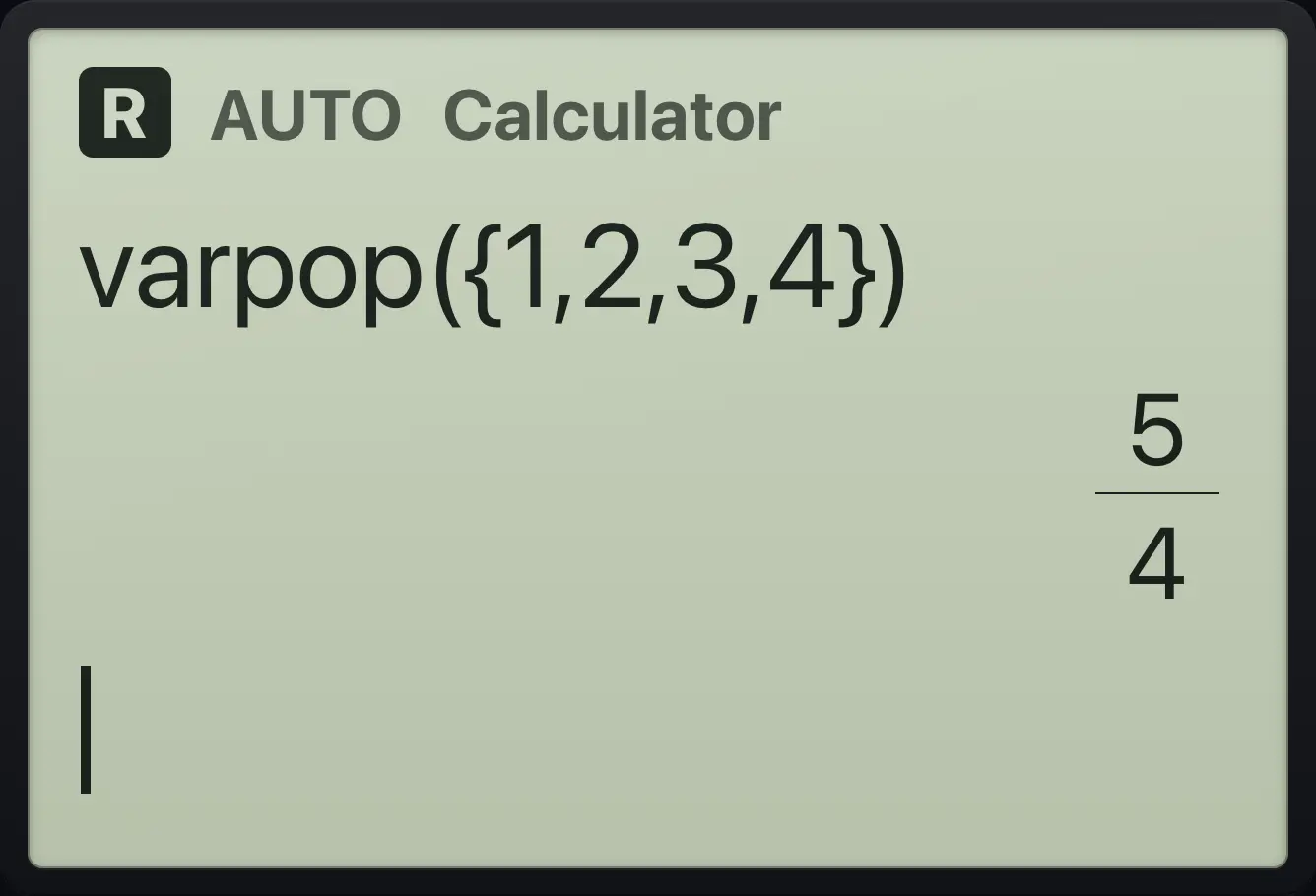
Result of the example "Population variance" The display shows: varpop({1,2,3,4}) / 5/4.
You should see5/4
Example 12.14

Sum and product

  1. Type product({1,2,3,4}).

    product(shift{(1,2,3,4shift}))enter
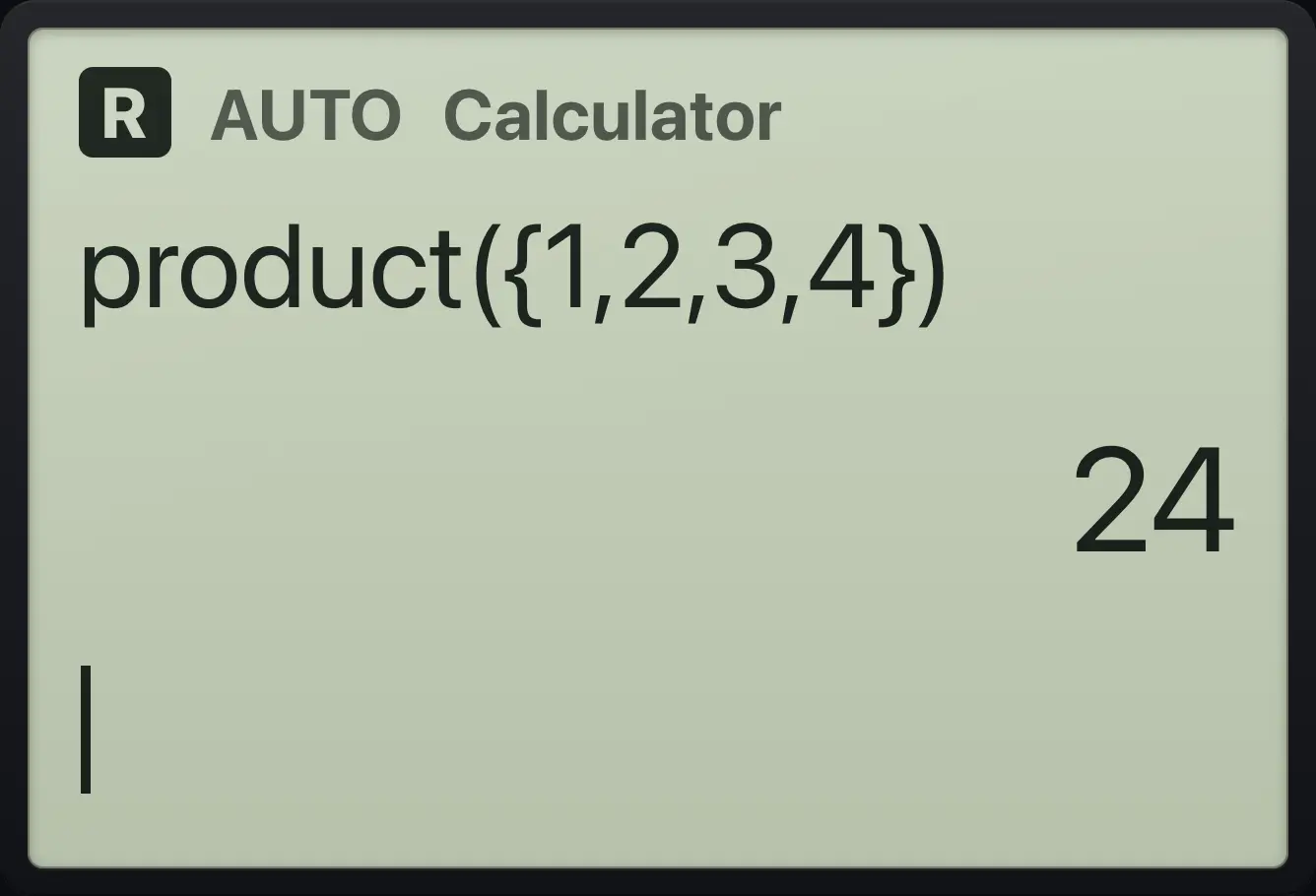
Result of the example "Sum and product" The display shows: product({1,2,3,4}) / 24.
You should see24
Example 12.15

Largest value

  1. Type max({1,5,2}).

    max(shift{(1,5,2shift}))enter
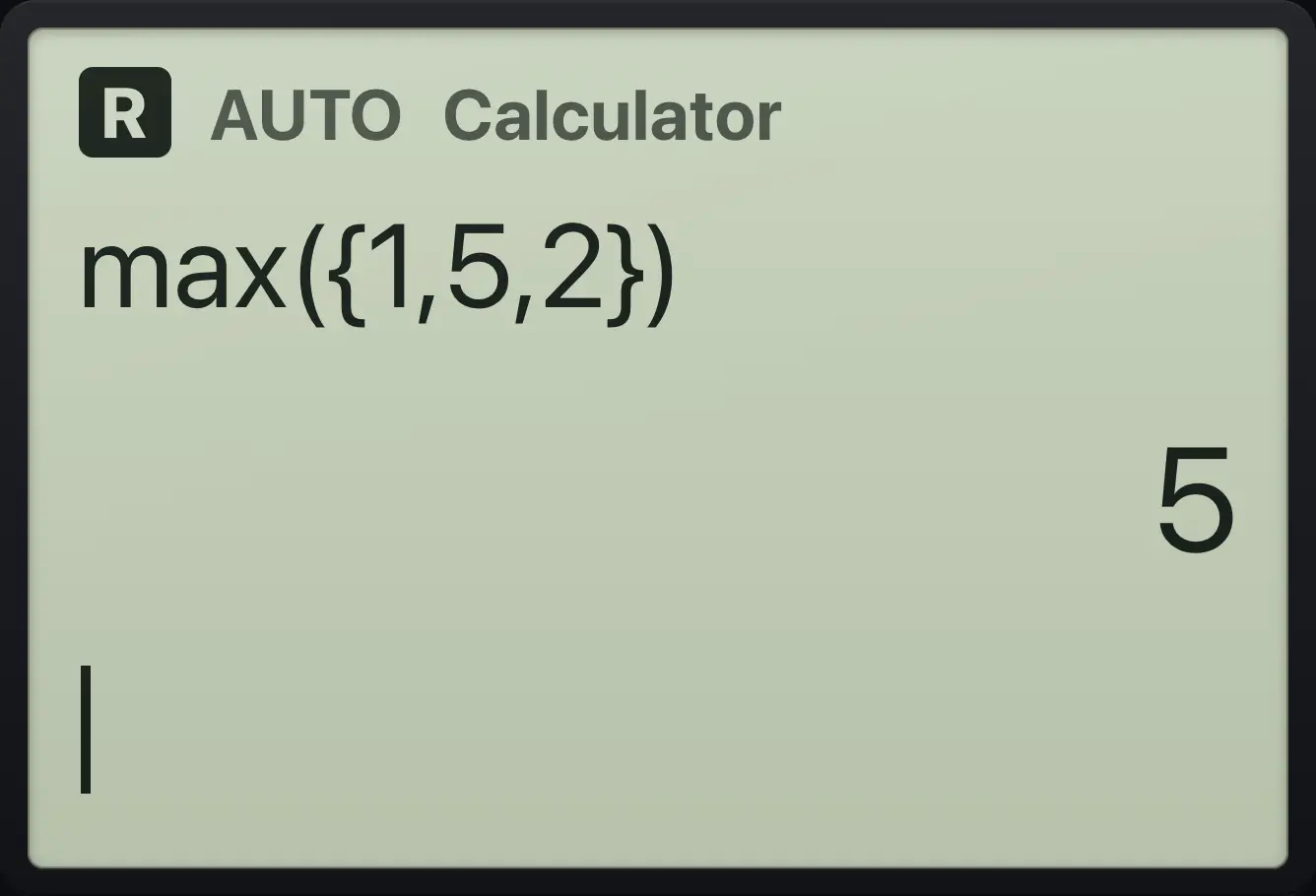
Result of the example "Largest value" The display shows: max({1,5,2}) / 5.
You should see5
Example 12.16

Sum with seq

∑n=1100n=5050\sum_{n=1}^{100}n=5050
  1. Type sum(seq(n,n,1,100)).

    sum(seq(n,n,1,100))enter
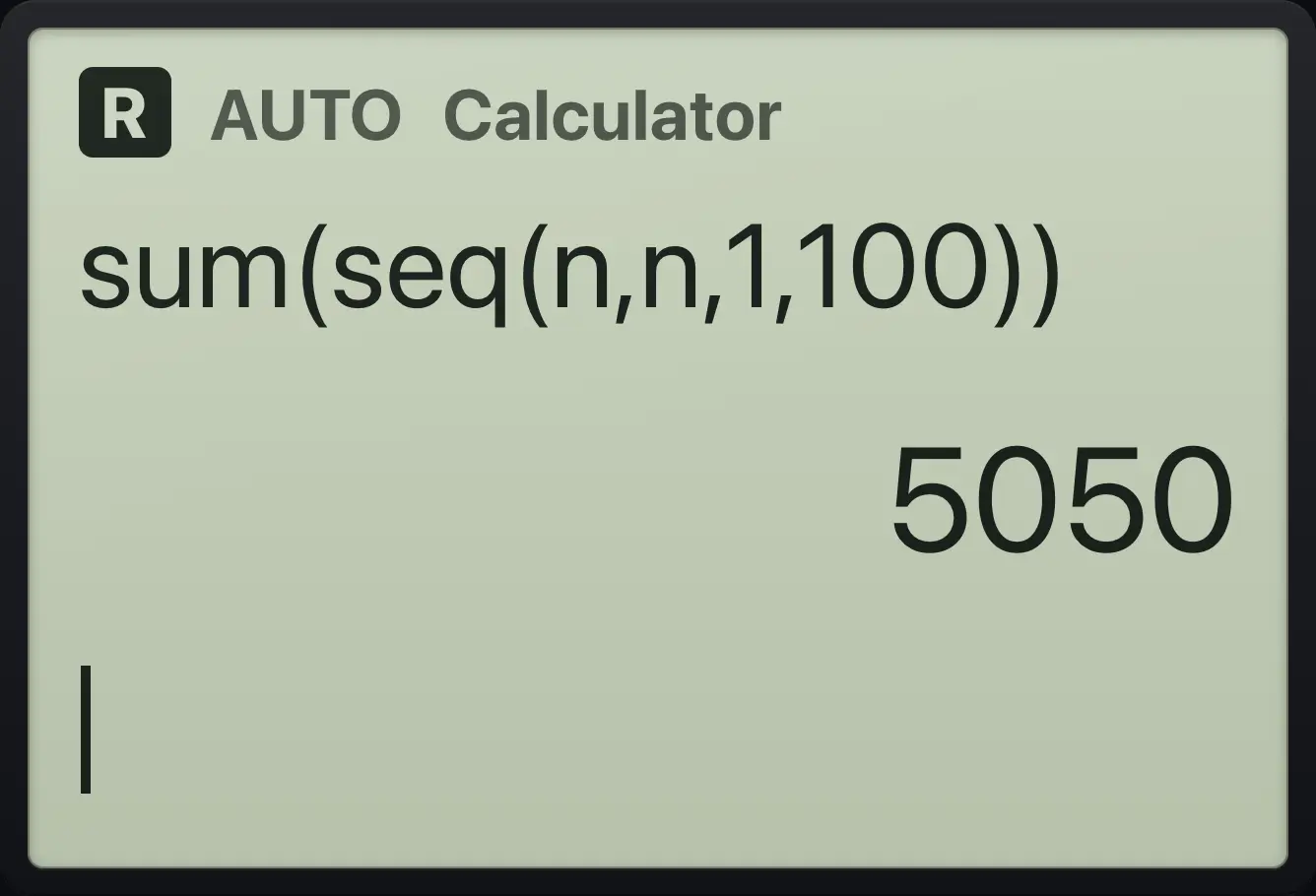
Result of the example "Sum with seq" The display shows: sum(seq(n,n,1,100)) / 5050.
You should see5050

12.3Normal, binomial, Poisson and t distributions#

The Probability menu (menu, 5) has the distribution functions. Arguments are separated by commas.

FunctionArgumentsMeaning
normCdflower, upper, mean, deviationProbability between two values
normPdfx, mean, deviationHeight of the bell curve
invNormarea, mean, deviationValue with that area to its left
binomPdf / binomCdfn, p, kExactly k / at most k successes
poissPdf / poissCdfmean, kExactly k / at most k events
geomPdf / geomCdfp, kFirst success on trial k / by trial k
tCdflower, upper, degrees of freedomProbability under the t curve
invtarea, degrees of freedomInverse t
f(x)=1σ2π e−(x−μ)22σ2f(x)=\frac{1}{\sigma\sqrt{2\pi}}\,e^{-\frac{(x-\mu)^{2}}{2\sigma^{2}}}
The normal density that normPdf evaluates.
Example 12.17

Within one deviation

  1. Type normCdf(−1,1,0,1).

    normcdf((−)1,1,0,1)enter
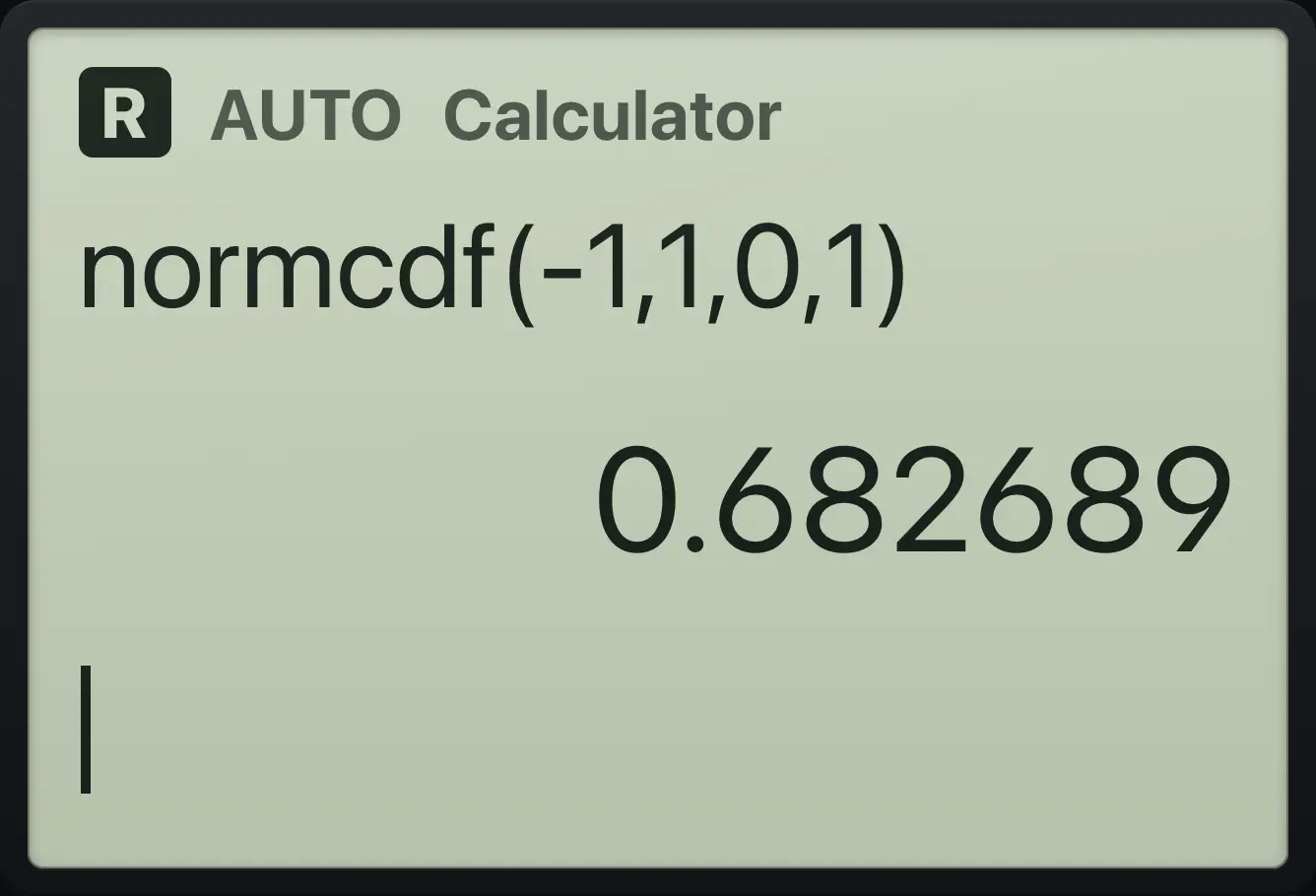
Result of the example "Within one deviation" The display shows: normcdf(-1,1,0,1) / 0.682689.
You should see0.682689
Example 12.18

Normal density at the mean

  1. Type normPdf(0,0,1).

    normpdf(0,0,1)enter
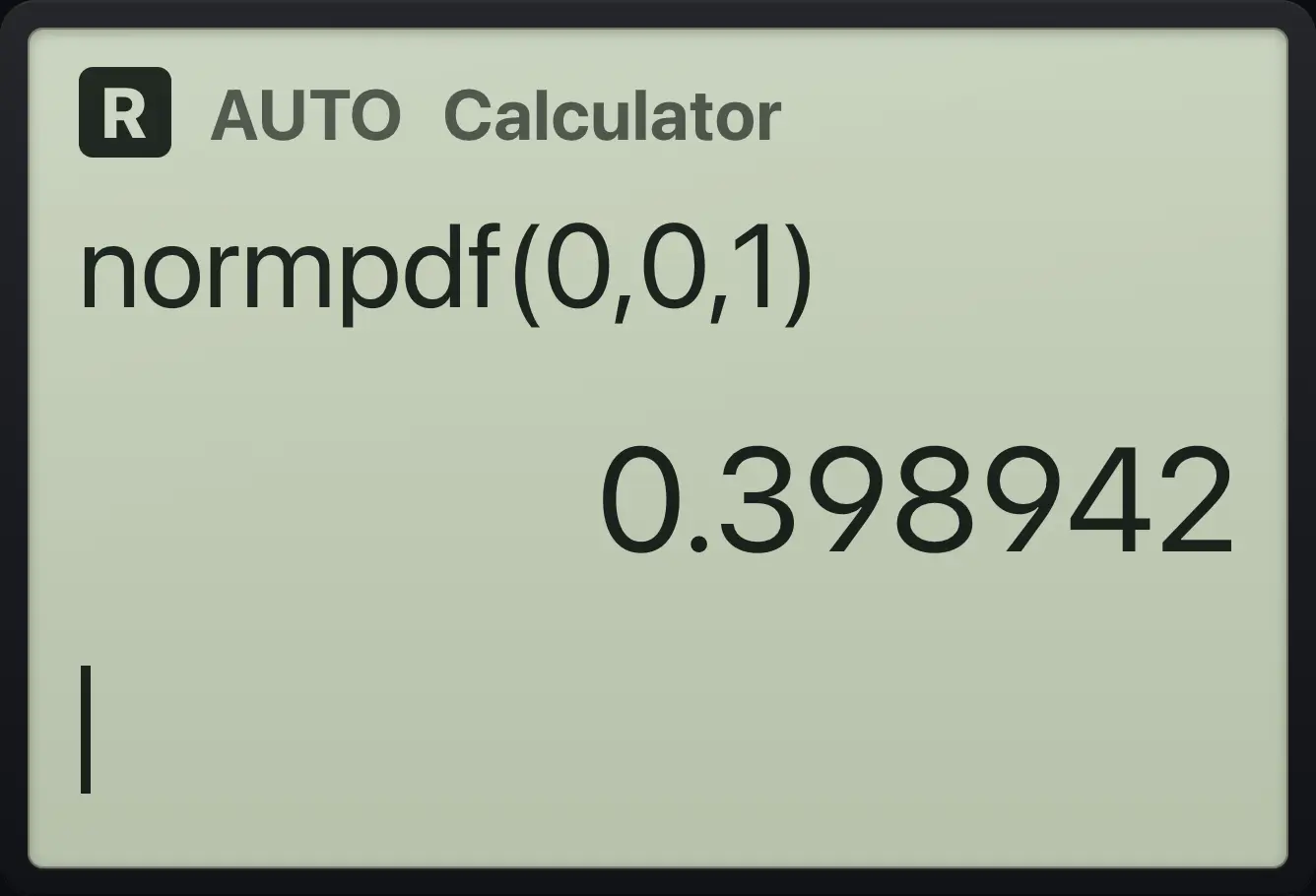
Result of the example "Normal density at the mean" The display shows: normpdf(0,0,1) / 0.398942.
You should see0.398942
Example 12.19

Inverse normal

  1. Type invNorm(0.975,0,1).

    invnorm(0.975,0,1)enter
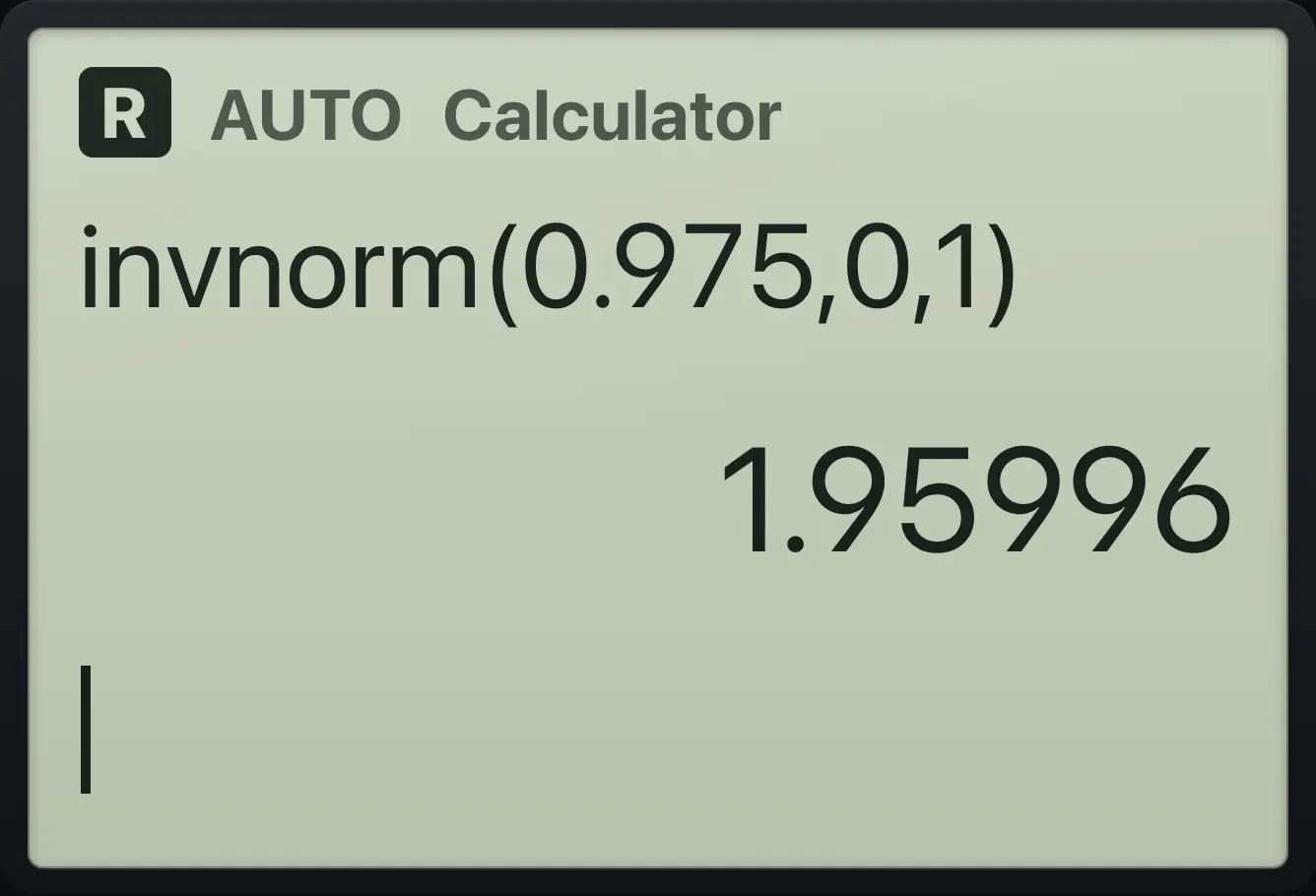
Result of the example "Inverse normal" The display shows: invnorm(0.975,0,1) / 1.95996.
You should see1.95996
Example 12.20

Binomial exactly 5

(105)(12)10≈0.2461\binom{10}{5}\left(\tfrac12\right)^{10}\approx 0.2461
  1. Type binomPdf(10,0.5,5).

    binompdf(10,0.5,5)enter
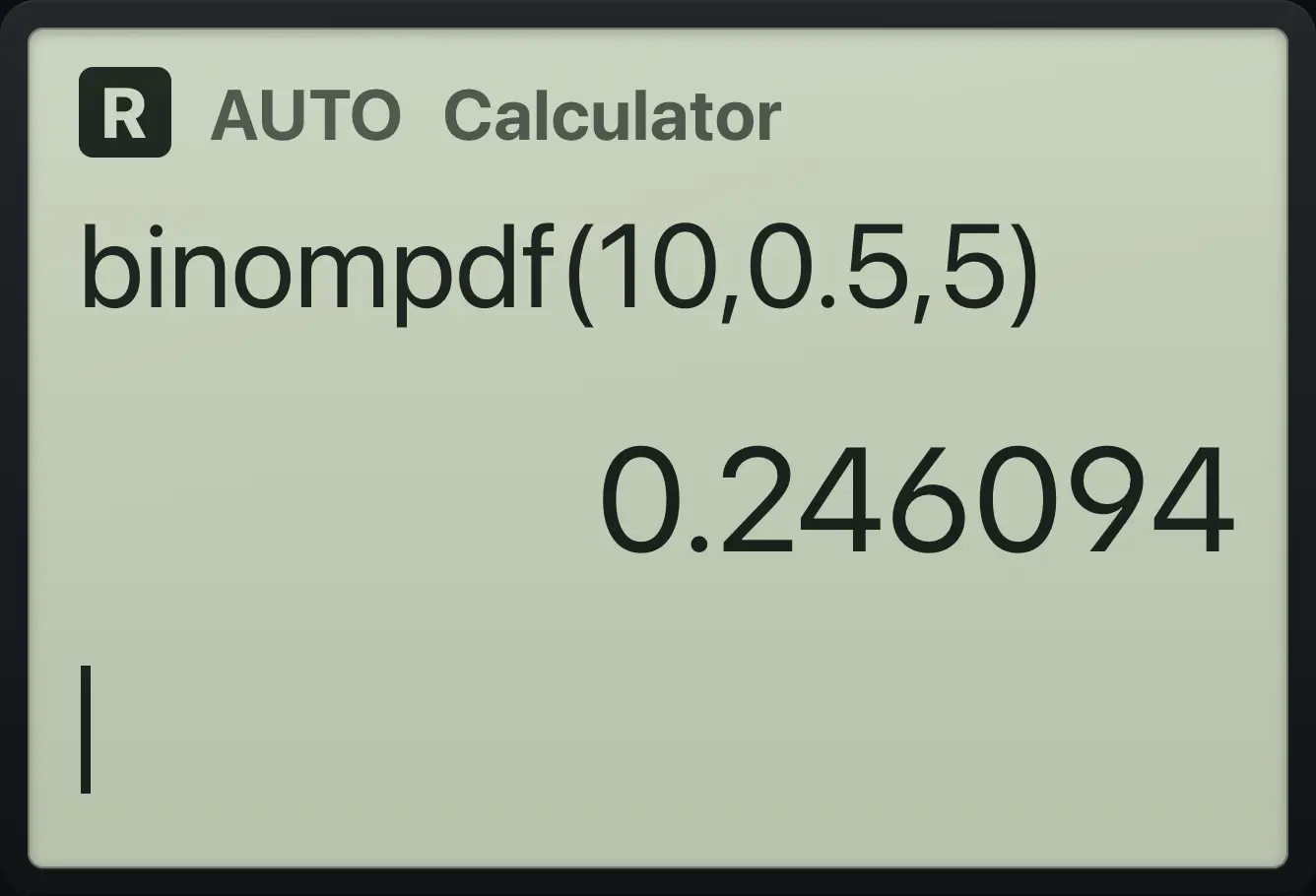
Result of the example "Binomial exactly 5" The display shows: binompdf(10,0.5,5) / 0.246094.
You should see0.246094
Example 12.21

Binomial at most 5

  1. Type binomCdf(10,0.5,5).

    binomcdf(10,0.5,5)enter
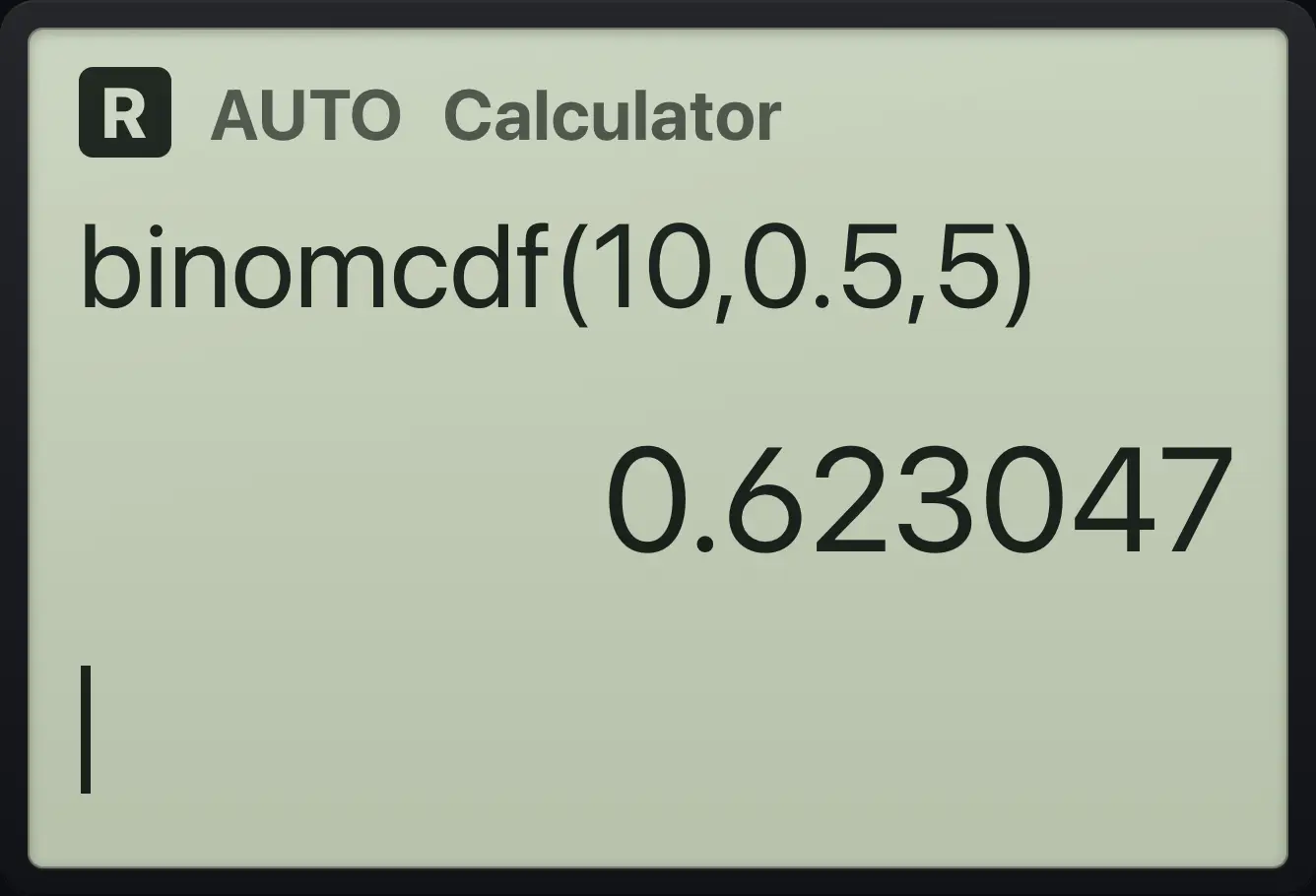
Result of the example "Binomial at most 5" The display shows: binomcdf(10,0.5,5) / 0.623047.
You should see0.623047
Example 12.22

Poisson exactly 3

  1. Type poissPdf(3,2).

    poisspdf(3,2)enter
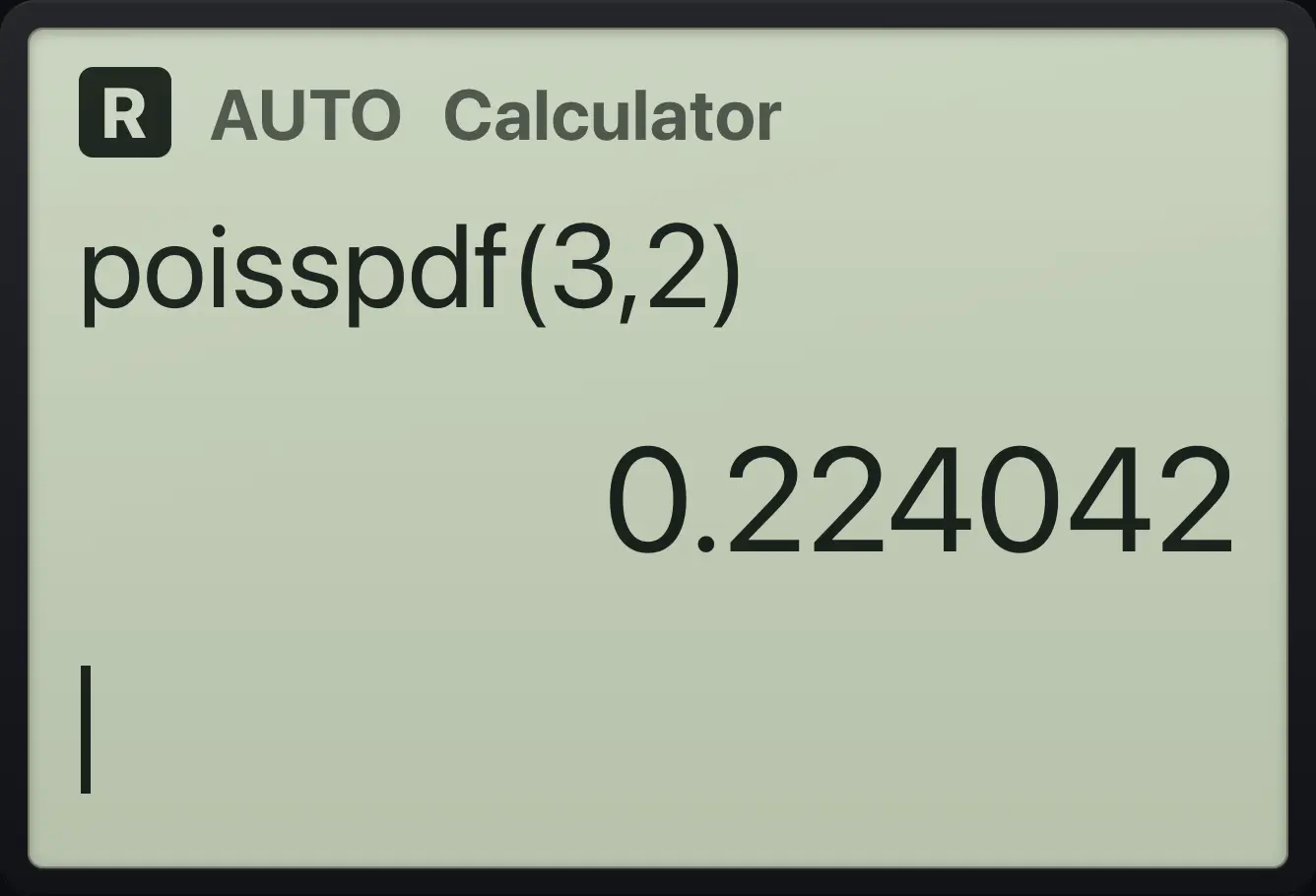
Result of the example "Poisson exactly 3" The display shows: poisspdf(3,2) / 0.224042.
You should see0.224042
Example 12.23

Student t

  1. Type tCdf(−2,2,10).

    tcdf((−)2,2,10)enter
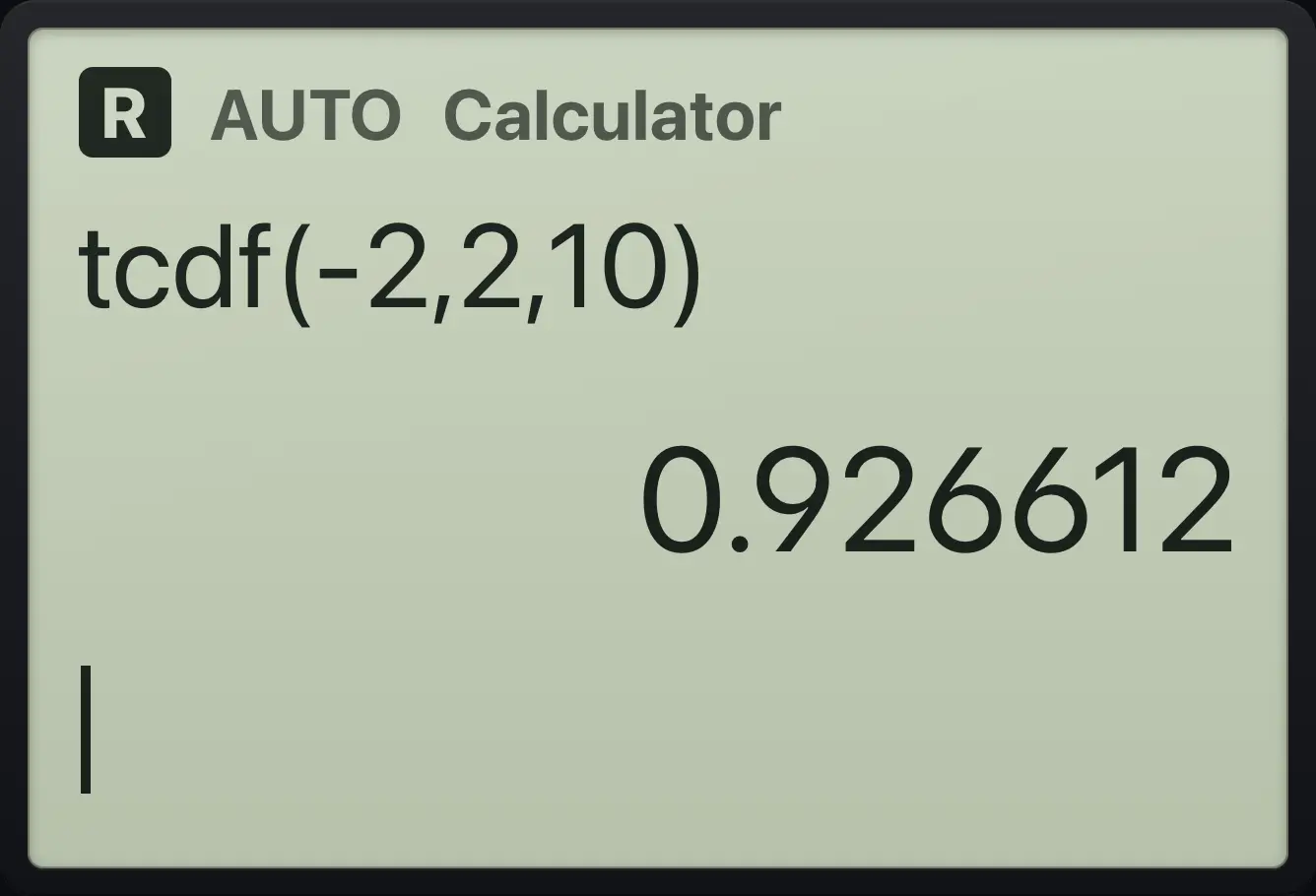
Result of the example "Student t" The display shows: tcdf(-2,2,10) / 0.926612.
You should see0.926612
Example 12.24

Critical t value

  1. Type invt(0.975,5).

    invt(0.975,5)enter
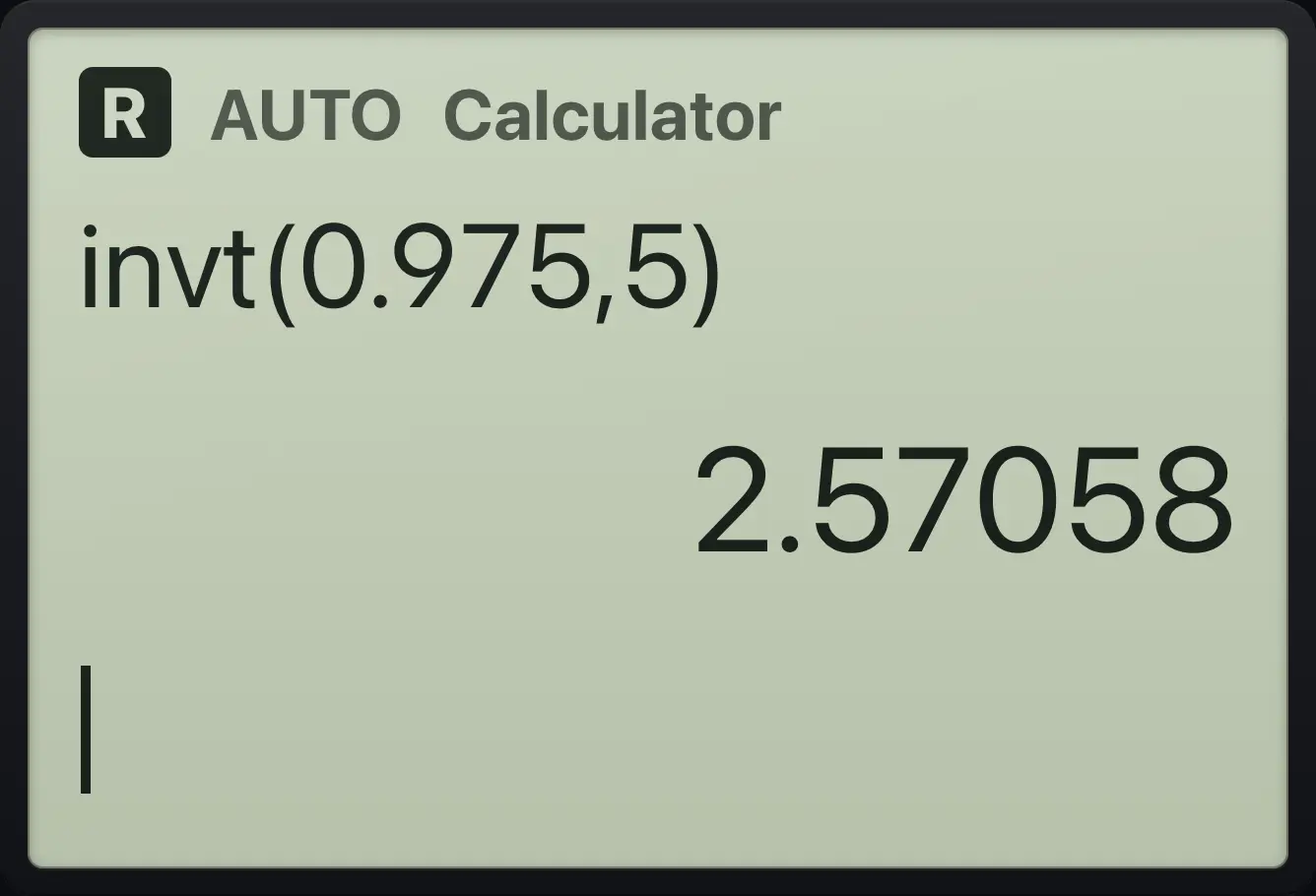
Result of the example "Critical t value" The display shows: invt(0.975,5) / 2.57058.
You should see2.57058

TI-Nspire CX CAS is a trademark of Texas Instruments Incorporated. Trident Calculator is an independent product by South View Studios and is not affiliated with, sponsored by or endorsed by Texas Instruments. The name is used only to describe the kind of calculator this model resembles; Trident's names, keys, display, fonts and software are its own clean-room design.